Blog - 03/08/2026
What Does Delaying a Home Lift Really Cost?
TL;DR
Delaying a home lift can increase long-term costs beyond the initial purchase price. Waiting until mobility declines may lead to higher medical expenses after stair-related falls, emergency home modifications, or reduced independence. Installing a home lift earlier gives homeowners more time to compare models, plan installation, and create a safer, more accessible home that supports aging in place and multi-generational living.
Quick Facts
- According to the World Health Organization (WHO), falls are one of the leading causes of injury-related death among older adults.
- A screw-driven home lift can usually be installed without a machine room and, depending on the model, requires little or no pit.
- Planning accessibility before mobility declines helps avoid emergency renovations and rushed decisions.
- Many Filipino families choose to age in place rather than relocate.
What You’ll Learn
By the end of this guide, you’ll understand:
- Why delaying a home lift can become more expensive over time.
- How stair-related falls increase healthcare costs.
- Why many Filipino families choose to age in place.
- How a home lift supports independent living.
- When is the best time to install a home lift.
How Can a Home Lift Help Prevent Costly Stair Fall Injuries?
For many Filipino homeowners, stairs are part of everyday life. Carrying groceries, laundry baskets, luggage, or simply moving between floors rarely feels difficult until age or mobility changes make each trip more challenging. As people grow older, the likelihood of losing balance or experiencing a serious fall increases, turning a familiar staircase into one of the biggest safety risks inside the home.
According to the World Health Organization (WHO), falls are one of the leading causes of injury and injury-related death among older adults worldwide. While not every fall results in serious harm, injuries involving the hip, spine, or head can require surgery, lengthy rehabilitation, and ongoing medical care. Beyond the financial impact, recovery often affects a person’s independence and quality of life.
A screw-driven home lift from Cibes Lift Philippines helps reduce the need to use stairs while requiring minimal structural modifications in many homes. Instead of repeatedly climbing up and down multiple floors, homeowners can move safely and comfortably throughout the house. Installing a residential lift before mobility becomes a concern is a practical way to improve home safety while supporting independent living for years to come.
What Can a Stair-Related Fall Cost?
The financial impact of a serious fall can quickly become significant. Depending on the severity of the injury and the required treatment, medical expenses may include emergency care, hospitalization, surgery, rehabilitation, and long-term support.
| Potential Expense | Typical Cost (Philippines) | Source |
|---|---|---|
| Emergency Room | ₱5,000–₱25,000 | DOH / Hospital estimate |
| Hip Surgery | ₱180,000–₱600,000 | Hospital estimates |
| Rehabilitation | ₱1,000–₱3,000/session | Local rehab clinics |
| Long-term caregiver | ₱18,000–₱40,000/month | Philippine caregiving rates |
Cost varies by hospital and treatment. Contact your healthcare provider for current estimates.
Beyond medical expenses, a serious fall can also reduce confidence, limit independence, and place additional emotional and financial pressure on family caregivers.
Although every situation is different, the potential costs highlight how quickly a stair-related fall can place financial pressure on a family. Planning for accessibility before an accident happens is often easier than making urgent decisions during a medical emergency.
Why Planning Ahead Matters
Many homeowners only begin considering a home lift after a family member starts having difficulty using the stairs. By then, accessibility has become an urgent need rather than a carefully planned home improvement.
Planning earlier offers several advantages:
- Compare different home lift models and features without pressure.
- Schedule installation at a convenient time.
- Budget more effectively instead of making emergency decisions.
- Improve home safety before mobility becomes a concern.
- Enjoy safer, easier access throughout the home for years to come.
Before choosing a home lift, it’s also worth understanding how screw-driven home lifts differ from hydraulic and traction systems. Knowing the differences can help you choose the right solution for your home and future mobility needs.
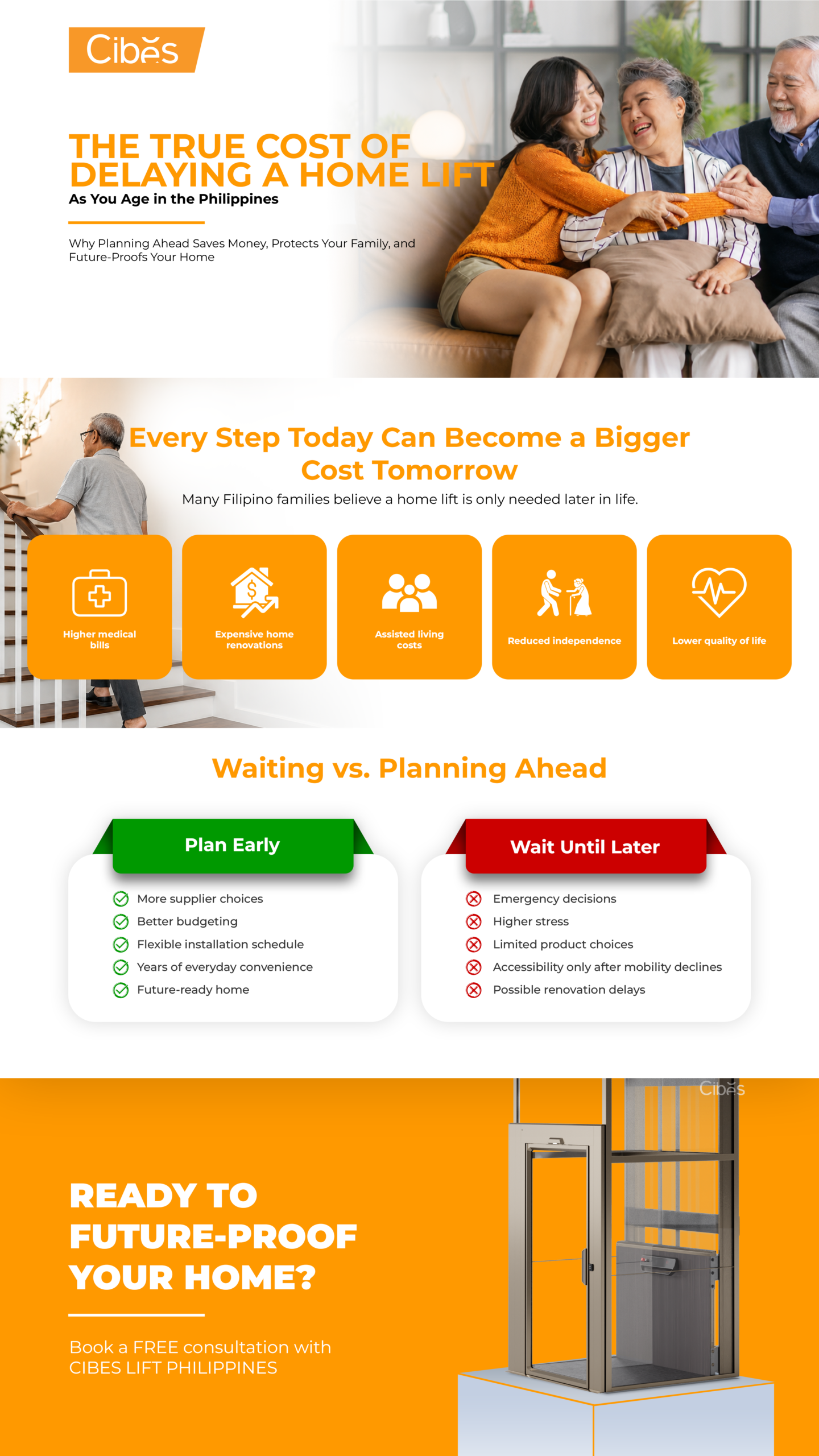
The true cost of delaying a home lift goes beyond the installation itself. Waiting until mobility declines can lead to higher medical expenses, rushed home renovations, and reduced independence. Planning ahead gives your family more choices, greater peace of mind, and a safer home for years to come.
A Home Lift Supports Everyday Independence
A home lift offers benefits beyond reducing the risk of stair-related falls. It also makes everyday movement between floors easier, safer, and more convenient for people of all ages. Carrying groceries, laundry, luggage, children’s items, or household supplies becomes simpler without relying on stairs. Family members recovering from injuries, living with chronic health conditions, or experiencing reduced mobility can continue accessing every floor of the home more independently.
For multi-generational Filipino households, this added accessibility helps grandparents, parents, and younger family members continue sharing the same home comfortably. Instead of adjusting daily routines around the stairs, the home can better adapt to the changing needs of the family over time.
How Can a Home Lift Increase Your Property Value in the Philippines?
A home is one of the biggest investments most Filipino families will ever make. While renovations such as updated kitchens, larger living spaces, or modern finishes can improve a property’s appeal, Accessibility is becoming an increasingly important consideration for long-term homeowners and future buyers.
According to the Philippine Statistics Authority, multi-generational households remain common across the country, making accessibility an important consideration when planning long-term housing. A home lift is increasingly viewed as more than a convenience. For many homeowners, it is a long-term investment that helps a house remain practical, comfortable, and functional for people of different ages and mobility levels.
Expert Insight
Installing a home lift before mobility declines allows homeowners to compare lift models, plan renovations carefully, and avoid emergency accessibility modifications.
Why Accessibility Adds Long-Term Value
A multi-storey home without an accessibility solution may become less practical for some buyers over time. Older adults, people recovering from injuries, and families planning to care for aging parents often look for homes that are easier to move around in without relying solely on stairs.
By installing a home lift, homeowners can make their property suitable for a wider range of potential buyers, including:
- Families planning for aging in place.
- Multi-generational households.
- Homeowners with elderly parents.
- People with mobility challenges.
- Buyers looking for a future-ready home.
This broader appeal can help a property remain competitive in the market, especially as demand for accessible homes continues to grow.
Does a Home Lift Increase Resale Value?
While a home lift does not guarantee a specific increase in resale price, it can make a property more attractive to buyers who value accessibility, aging in place, or multi-generational living. In premium residential markets, accessibility features may also help a property stand out from similar homes.
A home lift may help:
- Increase buyer interest.
- Differentiate the property from similar multi-storey homes.
- Reduce concerns about future accessibility.
- Appeal to families planning to stay in the home for many years.
- Support higher perceived value during resale discussions.
For many buyers, purchasing a home with an existing home lift is often more convenient than installing one after moving in. It reduces the need for future accessibility renovations and allows the home to be used comfortably from day one.
Should You Install a Home Lift Now or Wait?
Many homeowners delay installing a home lift because they believe they do not need one yet. However, waiting often means paying for accessibility improvements when mobility has already become a challenge.
| Install Early | Wait Until Needed |
|---|---|
| Better budgeting | Emergency spending |
| Wider lift selection | Limited choices |
| Planned installation | Urgent installation |
| Lower stress | Time pressure |
| Immediate convenience | Delayed benefits |
Planning ahead allows homeowners to make thoughtful decisions instead of reacting to changing health or family circumstances.
Future-Proofing Your Home
Future-proofing means preparing your home for changing needs without sacrificing comfort or style. A home lift helps ensure that every floor remains accessible whether your family grows, your parents move in, or mobility needs change over time.
Instead of relocating to a single-storey house or making expensive structural changes later, homeowners can continue enjoying the home they already love.
This approach is especially valuable in the Philippines, where many families build larger multi-storey homes intended to be passed down through generations. A home lift helps those homes remain functional for every generation, making accessibility part of the property’s long-term value.
Why More Filipino Families Are Installing Home Lifts Earlier
More Filipino homeowners are planning for future accessibility by installing a home lift before it becomes essential. For many families, it’s an investment in both everyday comfort and their property’s long-term usability.
Rather than viewing a residential lift as an expense, they see benefits that include:
- Safer movement between floors every day.
- Greater independence as family members age.
- Improved convenience for carrying groceries, luggage, and household items.
- Better accessibility for visitors with mobility challenges.
- A home that is prepared for changing family needs.
As awareness of aging in place continues to grow in the Philippines, accessible home design is becoming an increasingly important part of long-term property planning.
How Can a Home Lift Help Families Avoid the High Cost of Relocating Aging Parents?
For many Filipino families, the decision to move an aging parent out of the family home can be one of the most difficult choices a family faces. In many households, several generations live under one roof, making it possible for grandparents, parents, and children to support one another every day. When stairs become a barrier, however, families often feel they have limited options.
Installing a home lift before mobility becomes a serious concern can help families continue living together safely and comfortably. Rather than relocating an elderly parent or making major changes under pressure, homeowners can adapt the existing home to meet changing accessibility needs.
Why Do Families Consider Relocation?
As parents grow older, climbing stairs may become physically demanding or unsafe. Even simple daily activities, such as going to the bedroom, joining family meals upstairs, or accessing different parts of the home, can become challenging.
Without an accessibility solution, many families begin considering options such as:
- Moving aging parents into an assisted living facility.
- Purchasing or renting a separate single-storey home.
- Renovating the ground floor into a new bedroom.
- Selling the family home and relocating altogether.
While these options may improve accessibility, they often involve significant financial costs, major lifestyle adjustments, and emotional challenges for the entire family.
Comparing the Long-Term Costs
The cost of relocating or modifying a home can quickly add up over the years. Although every family’s situation is different, the following comparison highlights some of the long-term financial and lifestyle considerations homeowners often evaluate when planning for accessibility.
| Option | Possible Long-Term Financial Impact | Things to Consider |
|---|---|---|
| Assisted living | High recurring monthly expense | Ongoing costs that can continue for many years |
| Long-term assisted living | Significant long-term financial commitment | May exceed the cost of improving an existing home |
| Ground-floor bedroom conversion | Moderate to high renovation cost | May reduce living space and require structural work |
| Purchasing or renting another home | Varies significantly | Includes property, rental, moving, and maintenance costs |
Actual costs vary depending on location, property type, healthcare provider, and project scope.
The Emotional Cost Is Just as Important
Financial considerations are only one part of the decision.
For many older adults, home represents familiarity, independence, cherished memories, and a strong sense of belonging. Moving away from a familiar environment can affect emotional well-being, daily routines, and the sense of connection that comes from living close to family.
In the Philippines, where family relationships often play a central role in everyday life, remaining together in one home is an important priority. A home lift supports this lifestyle by helping every family member move comfortably between floors without giving up the home they love.
A Better Alternative for Aging in Place
Instead of relocating, many homeowners choose to improve accessibility within their existing property.
Installing a residential home lift allows families to:
- Help aging parents move safely between floors.
- Continue living together in one home.
- Reduce the need for expensive future renovations.
- Avoid emergency accessibility decisions.
- Support long-term independent living.
This approach also gives homeowners the opportunity to plan the installation carefully, compare lift models, and choose a solution that matches both their home and future needs.
A Home Designed for Every Generation
A home should continue serving your family through every stage of life. Children grow up, parents grow older, and family needs naturally change over time.
Rather than adapting your lifestyle to the limitations of stairs, a home lift allows your home to adapt to your family.
Whether you’re caring for aging parents today or planning for your own future, installing a home lift early helps create a safer, more accessible environment that supports independent living for decades to come.
How Can a Home Lift Help Prevent Social Isolation for Elderly Family Members?
Not every cost of delaying a home lift can be measured in pesos. One of the biggest yet often overlooked consequences is the gradual loss of independence and social connection within the family.
For many older adults, reduced mobility doesn’t happen overnight. It usually develops gradually, making everyday activities such as climbing stairs more tiring, uncomfortable, or unsafe. As a result, some family members begin avoiding the upper or lower floors of their own home, limiting where they spend their time and how often they interact with others.
Over time, these small adjustments can affect quality of life, confidence, and emotional well-being.
How Stairs Can Change Daily Life
In a multi-storey home, stairs connect every part of daily living. When using them becomes difficult, older adults may begin changing their routines to avoid unnecessary trips between floors.
They may choose to:
- Stay on one floor for most of the day.
- Skip family meals held upstairs or downstairs.
- Avoid carrying personal belongings between floors.
- Limit participation in family gatherings at home.
- Depend on other family members for simple daily tasks.
Although these changes may seem minor at first, they can gradually reduce independence and make everyday life less enjoyable.
Why Staying Connected Matters
In the Philippines, family life often revolves around spending time together. Birthdays, holiday celebrations, shared meals, and everyday conversations are important parts of many Filipino households.
When an older family member struggles to move freely around the home, they may unintentionally become less involved in these moments. Limited mobility can affect not only physical independence but also emotional well-being and overall quality of life.
Creating a home where everyone can comfortably access every floor helps ensure that grandparents, parents, children, and visitors continue sharing the same spaces and experiences.
A Home Lift Supports Independent Living
A home lift removes one of the biggest physical barriers inside a multi-storey home.
Instead of planning each trip around the stairs, homeowners can move comfortably between floors with greater confidence. This supports independent living while reducing the physical effort required for everyday activities.
A residential home elevator can also make daily routines easier by helping family members:
- Access every floor safely.
- Carry groceries, laundry, and luggage with less effort.
- Move children’s strollers or household items more comfortably.
- Welcome elderly relatives and guests with mobility challenges.
- Continue enjoying every part of the home without relying on assistance.
These everyday benefits extend well beyond older adults, making the home more practical for everyone.
Supporting Multi-Generational Living
Multi-generational living remains common across the Philippines, with several generations often sharing one household. A home lift helps preserve this lifestyle by making it easier for family members of different ages and physical abilities to live together comfortably.
Whether it’s helping grandparents visit their grandchildren upstairs, allowing parents to move heavy household items more easily, or making every bedroom accessible, improved mobility benefits the entire family.
Instead of adapting family life around accessibility limitations, homeowners can create a house that continues meeting their family’s needs for many years.
Accessibility Is About More Than Mobility
A home lift is not only an accessibility feature. It is also an investment in comfort, inclusion, and independence.
By making every floor easy to reach, homeowners create an environment where family members can continue participating in daily life regardless of age or mobility. This supports healthier, more active lifestyles while helping older adults remain connected to the people and places that matter most.
Why Should You Install a Home Lift Before You Need One?
The best time to install a home lift is usually before it becomes a necessity. Waiting until mobility has already declined often means making important decisions under pressure, with limited time to compare products, plan the installation, or prepare a budget.
Planning ahead gives homeowners more control over the process while allowing them to enjoy the benefits of a home lift for many years. Instead of reacting to a health event or accessibility challenge, families can create a safer and more comfortable home before those situations arise.
For many Filipino homeowners, installing a residential elevator is part of long-term home planning. Just as families invest in home security, energy-efficient upgrades, or renovations, a home lift is an improvement that supports comfort, convenience, and accessibility throughout different stages of life.
Why Waiting Can Become More Expensive
Many homeowners delay installing a home lift because they feel healthy and active today. While that is understandable, accessibility needs often change faster than expected.
An unexpected fall, surgery, illness, or mobility condition can quickly turn a planned home improvement into an urgent requirement.
When accessibility becomes an emergency, homeowners may face:
- Limited time to compare home lift suppliers.
- Higher stress during the buying process.
- Disruption to daily family routines.
- Emergency home modifications.
- Reduced flexibility when scheduling installation.
Planning ahead removes much of this pressure and allows every decision to be made carefully.
Planning Ahead Gives You More Choices
Installing a home lift early allows homeowners to focus on choosing the right solution instead of simply finding the fastest available option.
With more time available, families can compare:
- Lift sizes and capacities.
- Interior finishes and design options.
- Door configurations.
- Safety features.
- Future expansion plans.
- Installation schedules.
- Overall project budget.
This planning process helps ensure the lift complements both the home’s design and the family’s long-term needs.
Enjoy More Years of Everyday Convenience
One of the biggest advantages of early installation is simple: you get to use the lift for much longer.
A home lift is not only for people with mobility challenges. It makes everyday living easier for everyone in the household.
Daily activities become more convenient, including:
- Carrying groceries between floors.
- Moving luggage.
- Transporting laundry.
- Bringing furniture upstairs.
- Moving baby strollers.
- Assisting elderly relatives.
- Welcoming guests with mobility needs.
Rather than waiting until climbing stairs becomes difficult, homeowners can enjoy these everyday conveniences immediately.
A Home Lift Helps Future-Proof Your Home
Every family’s needs change over time.
Children grow older, parents retire, grandchildren visit, and lifestyles evolve. A home designed only for today’s needs may require expensive modifications in the future.
Installing a home lift helps future-proof a multi-storey home by making it accessible for different stages of life without requiring major structural changes later.
Future-proofing your home can help support:
- Aging in place.
- Multi-generational living.
- Long-term property usability.
- Everyday convenience.
- Greater independence.
- Improved accessibility for visitors and family members.
Rather than adapting to changing mobility, your home is already prepared for it.
Why More Filipino Families Are Planning Earlier
Across the Philippines, more homeowners are choosing to install home lifts while they are still active and independent.
Their reasons often include:
- Preparing for retirement.
- Supporting aging parents.
- Making a forever home more accessible.
- Increasing everyday convenience.
- Improving long-term property functionality.
- Reducing future renovation costs.
Instead of viewing a home elevator as something needed only later in life, many families now see it as part of building a home that will continue serving them for decades.
Home Lift Planning vs. Waiting Until Later
| Planning Ahead | Waiting Until Later |
|---|---|
| More supplier options | Limited choices due to urgency |
| Flexible installation schedule | Emergency scheduling may be required |
| Better budget planning | Unexpected accessibility expenses |
| Years of everyday convenience | Benefits only begin after mobility changes |
| Less stress during decision-making | Decisions often made under pressure |
| Home is ready for future needs | Accessibility improvements may be delayed |
Investing in Peace of Mind
While the financial benefits of planning ahead are important, many homeowners value something even more: peace of mind.
Knowing that every member of the family can move safely throughout the home provides confidence for today and reassurance for the future. Whether you’re carrying groceries, welcoming elderly relatives, or planning for retirement, a home lift helps create a house that remains comfortable, accessible, and practical for years to come.
Planning early isn’t about expecting mobility challenges. It’s about making thoughtful decisions that allow your family to continue enjoying the home you’ve worked hard to build.
Conclusion: A Home Lift Is an Investment in Your Future
The true cost of delaying a home lift is not limited to the installation itself. For many Filipino families, the bigger expenses often come later through medical treatment after stair-related falls, emergency home renovations, relocation, assisted living, or the gradual loss of independence.
Planning ahead gives homeowners the opportunity to make thoughtful decisions before accessibility becomes an urgent concern. Instead of reacting to changing mobility needs, families can prepare their homes for every stage of life while enjoying greater comfort, convenience, and peace of mind from day one.
A home lift also supports the way many Filipino families live. Multi-generational households remain common across the Philippines, and creating a home where grandparents, parents, children, and future generations can move freely between floors helps everyone stay connected. Accessibility is no longer just about mobility. It is about protecting your lifestyle, preserving your independence, and ensuring your home continues to serve your family for decades.
Whether you’re building a new home, renovating an existing property, or planning for retirement, installing a home lift early can help reduce future costs while making everyday life easier. Planning ahead gives you more choices, a smoother installation process, and years of practical use that benefit the entire household.
Why Choose Cibes Lift Philippines?
With more than 75 years of experience in lift engineering, Cibes has helped homeowners around the world create safer and more accessible homes. In the Philippines, Cibes Lift has installed hundreds of home lifts across residential, commercial, and public spaces, providing accessibility solutions that combine Scandinavian engineering with elegant design.
Unlike conventional elevators, Cibes home lifts are designed to fit more homes with minimal structural changes. They feature a space-efficient screw-driven system that typically does not require a machine room and can be installed with little or no pit, depending on the model and site conditions. This makes them well suited for both new homes and retrofit projects.
When you choose Cibes Lift Philippines, you benefit from:
- Swedish-designed home lift technology.
- Space-saving installation for many residential properties.
- Quiet and smooth everyday operation.
- Elegant Scandinavian-inspired designs that complement modern homes.
- Professional consultation, installation, and after-sales support.
- A nationwide presence with Experience Centers across the Philippines.
Whether your goal is to improve accessibility, support aging in place, or future-proof your home, our team can help you find a home lift that fits your family’s needs and your home’s design.
Ready to Plan Your Home Lift?
Every home is different, and the right home lift depends on your property’s layout, available space, and long-term accessibility goals.
Our specialists can help you:
- Explore the most suitable home lift models.
- Understand installation requirements.
- Compare available finishes and design options.
- Learn about customization possibilities.
- Request a tailored quotation for your home.
Planning for accessibility today can help you avoid difficult decisions tomorrow, allowing your family to enjoy a safer, more comfortable home for years to come.
Book a free consultation with Cibes Lift Philippines today and discover how a home lift can help you create a safer, more future-ready home for every generation.
Is It Better to Install a Home Lift Before You Need One?
In most cases, yes. Installing a home lift before mobility becomes a daily challenge gives homeowners more time to compare models, schedule installation, manage their budget, and prepare their home without the pressure of an emergency. It also allows families to enjoy safer, more convenient access between floors for many more years.
Frequently Asked Questions
Q: Why should I install a home lift before I need one?
A: Installing a home lift before mobility becomes a challenge allows you to plan the project without urgency. It gives you more time to compare different home lift models, choose the right design, and enjoy years of improved accessibility, comfort, and convenience before stairs become difficult to use.
Q: Is a home lift worth it for a multi-storey house?
A: Yes. A home lift makes everyday life easier by providing safe and convenient access between floors. It benefits older adults, children, people carrying heavy items, and anyone with temporary or permanent mobility challenges. Many homeowners also consider a home lift a long-term investment that helps support future accessibility and improves everyday convenience.
Q: Can a home lift help reduce the risk of stair-related falls?
A: A home lift reduces the need to use stairs, which can help lower the risk of falls, particularly for older adults and people with reduced mobility. While no solution can eliminate every accident, improving accessibility inside the home can contribute to a safer living environment.
Q: Does installing a home lift increase property value?
A: A home lift may increase a property’s appeal by making it more accessible and better suited for long-term living. While resale value depends on factors such as location, property condition, and market demand, accessibility features can make a home more attractive to buyers planning for aging in place or multi-generational living.
Q: Is it cheaper to install a home lift than relocate later?
A: For many families, installing a home lift may help reduce the need for costly relocation, major renovations, or long-term assisted living in the future. Every situation is different, but planning early gives homeowners more flexibility and may help avoid unexpected accessibility expenses later.
Q: What is the best age to install a home lift?
A: There is no single ideal age to install a home lift. Many homeowners begin planning in their 50s or 60s, before mobility changes become a daily concern.
Q: Can a home lift support aging in place?
A: Yes. A home lift makes it easier to move between floors, helping homeowners remain independent while continuing to live comfortably in their own homes. It is a practical accessibility solution for homeowners who want to age in place while remaining in the home they know and love.
Q: Are home lifts only for older adults?
A: No. Home lifts are designed for anyone who wants easier access between floors. They are useful for families with young children, pregnant women, homeowners carrying groceries or luggage, people recovering from injuries, wheelchair users, and older adults.
Q: What are the benefits of a home lift for multi-generational families?
A: A home lift allows grandparents, parents, children, and visitors to move safely between floors. It supports independent living, improves accessibility, and helps families continue living together comfortably as their needs change over time.
Q: Can a home lift be installed in an existing house?
A: Yes. Many modern home lifts are designed for both new builds and existing homes. Depending on the model and your property’s layout, installation often requires only minimal structural modifications, depending on the lift model and your home’s layout. A professional site assessment can determine the most suitable solution for your home.
Q: How much space is needed for a home lift?
A: The required space depends on the lift model, travel height, and capacity. Many residential home lifts are designed with compact footprints, making them suitable for homes where space is limited. A professional site assessment can help determine the most suitable home lift for your available space and accessibility needs.
Learn More:
- The Complete Guide to Home Lifts for Filipino Homeowners
- Home Lift vs. Second Floor Addition: Which Investment Makes More Sense
Thinking about adding a home lift?
Contact Cibes Lift Philippines Inc. to learn more or schedule your installation.
Phone: 0917 555 7054 / (027) 529 1128 | Email: ph@cibeslift.com
Experience Center’s and Technical Station Address
Makati City | Balintawak – Quezon City | Mandaluyong City | Cebu City | Ilo-Ilo City | Davao City | Cagayan De Oro City






CIBES AUTHOR
Jovelyn Guidaven has been a Sales Manager at Cibes Lift Philippines since 2021, helping homeowners, architects, designers, and developers find the right home lift solutions for their projects. She works closely with clients throughout the sales process, providing expert guidance and personalized recommendations based on their accessibility and mobility needs.



TL;DR The Cibes Experience Center Visayas in Cebu City lets homeowners, architects, designers, contractors, and developers see Cibes home lifts in person. Visitors can experience the lift cabin, review available designs and features, and discuss installation requirements with the Cibes team. The Cebu Experience Center currently lists V90 Elegance, Z85 Antera, and Ascenda among its […]

TL;DR Cibes Experience Center Luzon lets homeowners and property professionals experience Cibes home lifts in person before making a decision. Cibes Lift Philippines has 13 demo lifts across three Luzon Experience Centers: Makati (8), Mandaluyong (2), and Balintawak, Quezon City (3). Visitors can ride the lifts, check cabin space, test the controls, explore designs, and […]

TL;DR Sustainable home elevators in the Philippines are becoming an important consideration for homeowners who want to improve accessibility without overlooking environmental responsibility. Modern home elevators can support energy-efficient living through efficient drive systems, durable materials, renewable energy integration, and reduced structural changes compared with major home renovations. The Environmental Case for Sustainable Home Elevators […]

TL;DR Home Elevator Performance plays an important role in the safety, comfort, efficiency, and long-term reliability of a residential lift. While regular maintenance keeps your elevator operating reliably, proper usage, environmental control, component monitoring, electrical optimization, and timely upgrades can further improve its performance. In this guide, discover 8 expert tips to help maximize home […]

TL;DR Vacuum elevators use air pressure instead of cables or hydraulic systems to move a cabin inside a transparent tube. Most residential models require only 75 to 100 cm of space, serve 2 to 4 floors, carry 205 to 238 kg, and can often be installed in 2 to 3 days with minimal structural work. […]