Blog - 06/08/2026
Home Lift Lifespan: How Long Does a Home Lift Last?
TL;DR
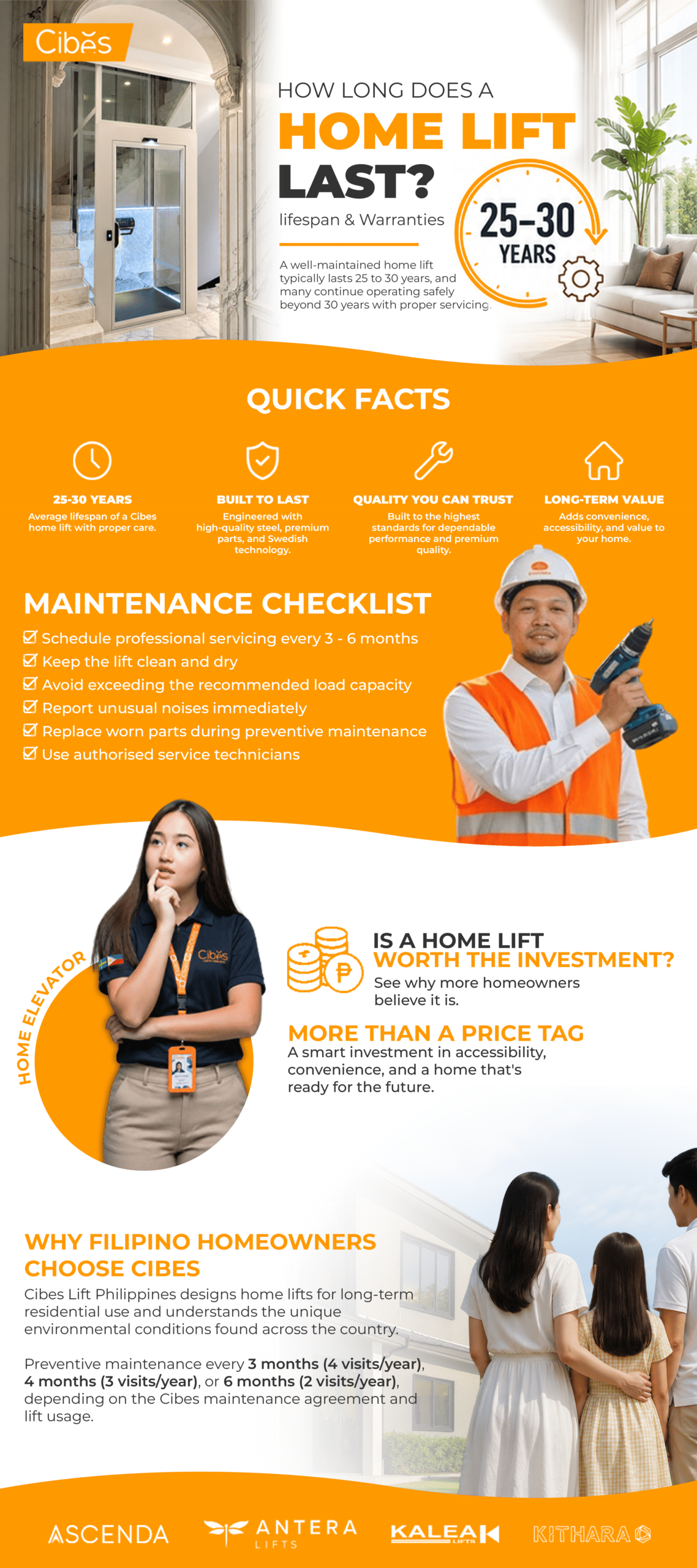
A well-maintained home lift typically lasts 25 to 30 years, and many continue operating safely beyond 30 years with proper servicing. In the Philippines, regular maintenance every 4 to 6 months helps protect the lift against humidity, heat, and coastal conditions. Cibes home lifts are designed for long-term residential use, making them a practical investment for homeowners planning to stay in their homes for decades.
Home Lift Lifespan at a Glance
| Question | Answer |
| Average home lift lifespan | 25-30 years |
| Can it last beyond 30 years? | Yes, with proper maintenance |
| Recommended servicing | Preventive maintenance every 3 months (4 visits/year), 4 months (3 visits/year), or 6 months (2 visits/year), depending on the Cibes maintenance agreement and lift usage. |
| Main factors affecting lifespan | Maintenance, usage, installation quality, climate |
| Philippine climate impact | High humidity and coastal environments increase wear |
| Suitable for | Long-term residential use |
When Do Home Lifts Need Replacing?
For most Filipino homeowners, a home lift is one of the biggest investments they’ll make after building or renovating their home. Naturally, one of the first questions is:
“How long will my home lift actually last?”
The good news is that a high-quality home lift isn’t something you’ll replace every few years. When installed correctly and serviced regularly, a premium residential lift can provide reliable performance for decades.
For many families, the same lift continues serving parents, children, and even future generations living in the same home.
How Long Do Home Lifts Typically Last?
A modern home lift generally lasts 25 to 30 years under normal residential use.
Many systems continue operating beyond 30 years when they receive regular preventive maintenance and worn components are replaced before failure.
Like any mechanical equipment, a home lift doesn’t suddenly stop working because it reaches a certain age. Instead, components naturally wear over time, allowing technicians to identify and replace parts during scheduled servicing.
For homeowners in the Philippines, routine maintenance is the biggest factor that determines whether a lift reaches or even exceeds its expected lifespan.
What Happens to a Home Lift Over Time?
Understanding how a home lift ages helps homeowners know what to expect throughout its life.
| Lift Age | Expected Condition | Components to Monitor | Recommended Action |
| 1-10 Years | Excellent condition | General inspection | Regular servicing |
| 10-15 Years | Minor wear begins | Batteries, door seals, lighting | Preventive replacement |
| 15-20 Years | Good condition with increased maintenance | Motors, gears, drive system | More detailed inspections |
| 20-30+ Years | Still reliable with proper servicing | Control systems, motors, mechanical components | Scheduled component replacement when needed |
Regular inspections help identify wear before it becomes a costly repair.
What Factors Affect the Lifespan of a Home Lift?
Several factors determine whether your lift reaches its full lifespan.
Regular Maintenance
The single most important factor is preventive maintenance.
For homes in the Philippines, servicing every 4 to 6 months is generally recommended due to the country’s tropical climate.
Routine servicing allows technicians to:
- Replace worn components
- Lubricate moving parts
- Check safety systems
- Prevent unexpected breakdowns
Skipping maintenance often results in premature wear and more expensive repairs later.
Frequency of Use
A lift used dozens of times every day naturally experiences more wear than one used occasionally.
Even so, modern residential lifts are engineered to withstand daily household use for many years.
Installation Quality
A professionally installed home lift performs more efficiently throughout its lifespan.
Proper alignment, electrical setup, and structural preparation reduce unnecessary stress on mechanical components.
Philippine Climate
The local environment plays a significant role in long-term reliability.
Metro Manila
Higher humidity can increase moisture around electrical and mechanical components.
Cebu and Batangas
Homes near the coast experience greater salt exposure, which may accelerate corrosion if not properly maintained.
Davao
Warm temperatures and year-round humidity make regular servicing equally important.
Fortunately, scheduled maintenance helps minimise these environmental effects.
What Warranty Comes with a Home Lift?
Warranty coverage varies depending on the manufacturer and model, but homeowners can generally expect coverage for major mechanical and electrical components.
Typical warranty coverage includes:
| Coverage | Typical Duration |
| Comprehensive parts and labour | 2-3 years |
| Major mechanical components | 5-10 years |
| Structural components | Varies by manufacturer and product |
Most warranties do not cover:
- Normal wear items
- Batteries
- Door seals
- Cosmetic damage
- Damage caused by misuse
- Unauthorised modifications
Always review the official warranty provided with your specific lift model.
Can a Home Lift Last More Than 30 Years?
Yes.Many residential home lifts continue operating safely beyond 30 years when they receive consistent maintenance.
Much like a well-maintained vehicle, replacing worn components before failure significantly extends the overall lifespan of the equipment.
Rather than replacing the entire lift, homeowners typically replace individual components as they age.
Home Lift Maintenance Checklist
Follow these simple practices to maximise your lift’s lifespan.
• Schedule professional servicing every 4-6 months
• Keep the lift clean and dry
• Avoid exceeding the recommended load capacity
• Report unusual noises immediately
• Replace worn parts during preventive maintenance
• Use authorised service technicians
Why Filipino Homeowners Choose Cibes
Cibes Lift Philippines designs home lifts for long-term residential use and understands the unique environmental conditions found across the country.
Whether installed in Metro Manila, Cebu, Davao, or other regions, regular maintenance helps homeowners enjoy reliable performance for decades.
Combined with professional installation and scheduled servicing, a Cibes home lift becomes a practical solution for families planning to age comfortably in their own homes.
Frequently Asked Questions
Q: How long does a home lift typically last?
A: A quality home lift typically lasts 25 to 30 years, and many continue operating beyond 30 years with proper maintenance.
Q: How often should a home lift be serviced in the Philippines?
A: Professional servicing every 4 to 6 months is generally recommended because of the country’s tropical climate.
Q: Does humidity affect a home lift?
A: Yes. High humidity, heat, and coastal salt exposure can increase wear on certain components. Regular maintenance helps reduce these effects.
Q: Can a home lift increase property value?
A: A home lift may improve a property’s appeal, particularly for buyers looking for accessible, multi-generational homes. While it does not guarantee a higher resale price, it can make a property more attractive in the market.
Q: What parts usually wear out first?
A: Components such as batteries, door seals, lighting, and other consumable parts generally require replacement before major mechanical components.
Q: Is it better to repair or replace an older home lift?
A: Most home lifts do not require complete replacement after 20 years. Replacing individual components during scheduled maintenance is usually more cost-effective than installing a new lift.
Q: What is covered by a home lift warranty?
A: Warranty coverage varies by manufacturer and model but commonly includes major mechanical and electrical components. Consumable items, cosmetic wear, misuse, and unauthorised modifications are typically excluded.
Learn more:
• Home Lift Maintenance Tips 2026 – Cibes Philippines
• Tropical Home Lift Features for Philippine Homes | Cibes
• Home Elevator Installation Complete Guide – Cibes Philippines
Experience Center’s and Technical Station Address
Makati City | Balintawak – Quezon City | Mandaluyong City | Cebu City | Ilo-Ilo City | Davao City | Cagayan De Oro City






CIBES AUTHOR
Mylen Posas is the Aftersales Manager at Cibes Lift Philippines. She oversees aftersales operations, ensuring every customer receives reliable support from installation through long-term maintenance. With a strong focus on service quality and customer satisfaction, she works closely with the technical team to deliver prompt assistance and help maintain the long-term performance and safety of every Cibes home lift.



TL;DR The Cibes Experience Center Visayas in Cebu City lets homeowners, architects, designers, contractors, and developers see Cibes home lifts in person. Visitors can experience the lift cabin, review available designs and features, and discuss installation requirements with the Cibes team. The Cebu Experience Center currently lists V90 Elegance, Z85 Antera, and Ascenda among its […]

TL;DR Cibes Experience Center Luzon lets homeowners and property professionals experience Cibes home lifts in person before making a decision. Cibes Lift Philippines has 13 demo lifts across three Luzon Experience Centers: Makati (8), Mandaluyong (2), and Balintawak, Quezon City (3). Visitors can ride the lifts, check cabin space, test the controls, explore designs, and […]

TL;DR Sustainable home elevators in the Philippines are becoming an important consideration for homeowners who want to improve accessibility without overlooking environmental responsibility. Modern home elevators can support energy-efficient living through efficient drive systems, durable materials, renewable energy integration, and reduced structural changes compared with major home renovations. The Environmental Case for Sustainable Home Elevators […]

TL;DR Home Elevator Performance plays an important role in the safety, comfort, efficiency, and long-term reliability of a residential lift. While regular maintenance keeps your elevator operating reliably, proper usage, environmental control, component monitoring, electrical optimization, and timely upgrades can further improve its performance. In this guide, discover 8 expert tips to help maximize home […]

TL;DR Vacuum elevators use air pressure instead of cables or hydraulic systems to move a cabin inside a transparent tube. Most residential models require only 75 to 100 cm of space, serve 2 to 4 floors, carry 205 to 238 kg, and can often be installed in 2 to 3 days with minimal structural work. […]