Blog - 14/08/2026
Do You Need Essential Permits to Install a Home Lift in the Philippines?
TL;DR
Permits to Install a Home Lift are usually required in the Philippines before a residential lift can be legally installed. Home lifts are legal in the Philippines, but they must comply with local building regulations. Most residential installations require a building permit from your local government and must follow the National Building Code of the Philippines (NBCP), applicable mechanical and lift safety requirements, and, where applicable, Batas Pambansa Bilang 344 (BP 344) for accessibility.
Meeting these requirements helps ensure your home lift is installed safely, passes inspections, avoids construction delays, and complies with Philippine regulations. Whether you’re building a new home or renovating an existing one, understanding these requirements is the first step toward a smooth installation.
The good news is that home lifts are legal in the Philippines. Residential lift installations are regulated through the National Building Code of the Philippines (NBCP), applicable mechanical and lift safety requirements, and accessibility requirements under Batas Pambansa Bilang 344 (BP 344) where applicable, and local government building permit procedures.
Following these requirements helps ensure your lift is installed safely, inspected properly, and compliant with local regulations. It can also reduce delays during construction while protecting your home’s long-term value.
Following these requirements helps ensure your lift is installed safely, inspected properly, and compliant with local regulations. It can also reduce delays during construction while protecting your home’s long-term value.
This guide explains everything homeowners need to know before installing a residential home lift in the Philippines.
A quick guide to the permits, building codes, electrical standards, and accessibility requirements for installing a home lift in the Philippines.
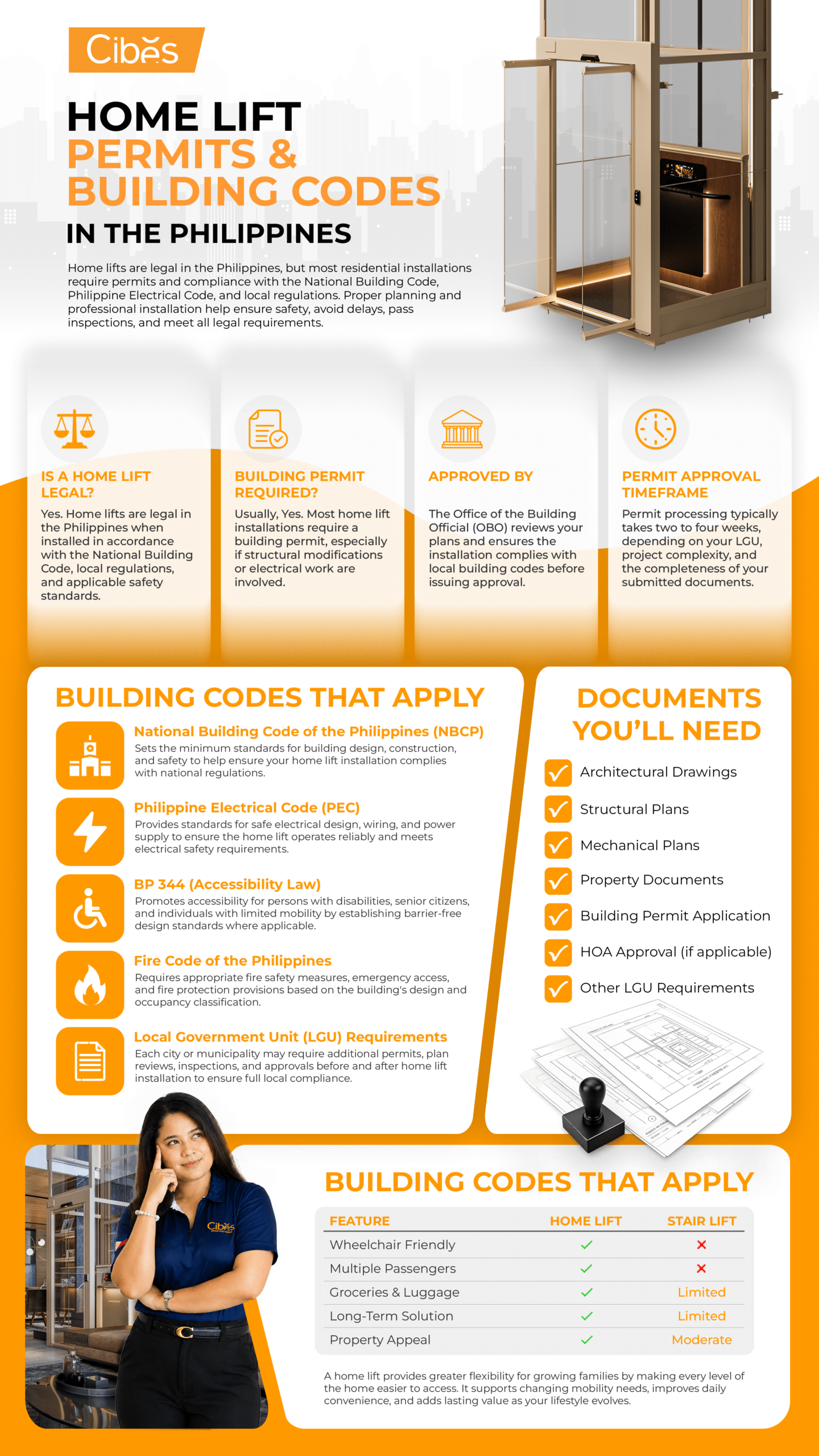
A quick guide to the permits, building codes, electrical standards, and accessibility requirements for installing a home lift in the Philippines.
Yes, home lifts are legal in the Philippines. Most residential installations require approval from the local building official and must comply with the National Building Code, the Philippine Mechanical Code, and accessibility standards where applicable. Working with an experienced installer helps simplify documentation, permitting, and inspections while ensuring the lift meets current safety requirements.
Home Lift Permit Requirements at a Glance
| Question | Answer |
|---|---|
| Are home lifts legal in the Philippines? | Yes |
| Is a building permit usually required? | Yes, in most residential projects |
| Which building code applies? | National Building Code of the Philippines (NBCP) |
| Which mechanical requirements apply? | Applicable mechanical and lift safety requirements |
| Do accessibility rules apply? | Yes, when the lift is intended for persons with disabilities or where required by regulations |
| Who approves the permit? | Local Building Official (LGU) |
| How long does permit approval usually take? | Approximately 2-4 weeks in Metro Manila, depending on project complexity |
| Can a home lift be installed in an existing house? | Yes, subject to structural assessment |
| Can an installer assist with permits? | Yes, experienced installers typically help prepare technical documentation |
Why Understanding Building Codes Matters
Many homeowners think permits are simply paperwork that slows down a project. In reality, building regulations exist to protect homeowners, their families, and the long-term value of their property.
A properly permitted home lift installation helps ensure:
- Structural safety
- Reliable mechanical and lift operation
- Safe operation during everyday use
- Compliance with local regulations
- Easier property resale
- Better insurance confidence
- Accessibility for future mobility needs
These requirements are especially important as more Filipino families choose to age in place instead of relocating to assisted living facilities.
Whether your project is located in Metro Manila, Makati, Quezon City, Pasig, Cebu City, Davao City, Iloilo City, Cagayan de Oro, or another part of the Philippines, understanding the approval process before construction begins can save time, reduce unexpected costs, and prevent unnecessary project delays.
What Building Codes Apply to Home Lifts in the Philippines?
Several regulations may apply to a residential home lift installation. Each serves a different purpose, but together they help ensure the lift is safe, reliable, and suitable for residential use.
| Regulation | Purpose | Applies To |
|---|---|---|
| National Building Code of the Philippines (NBCP) | Structural safety and building compliance | All residential home lift installations |
| Applicable mechanical and lift safety requirements | Lift mechanism, installation, and safe operation | Residential home lift installations |
| BP 344 (Accessibility Law) | Accessibility requirements for persons with disabilities | Where applicable |
Fire Code of the Philippines | Fire protection measures | Depending on building design and local requirements |
| Local Government Unit (LGU) Requirements | Building permits and inspections | Varies by city or municipality |
Not every home requires exactly the same documentation or approval process. Local government units (LGUs) may have additional requirements depending on the property’s location, building classification, and renovation scope.
Is a Home Lift Legal Under the National Building Code of the Philippines?
Yes. The National Building Code of the Philippines (NBCP) allows residential home lifts when they are properly designed, installed, and approved according to applicable building regulations.
The code does not prohibit installing a home elevator in a private residence. Instead, it establishes minimum safety standards to ensure the installation is structurally sound and suitable for long-term use.
For homeowners, this means choosing equipment that complies with recognized safety standards and working with qualified professionals who understand Philippine building requirements.
The National Building Code generally focuses on several important areas:
| Requirement | Why It Matters |
|---|---|
| Structural integrity | Ensures the home can safely support the lift installation |
| Installation safety | Reduces operational risks |
| Fire protection | Helps limit fire and smoke spread where required |
| Emergency provisions | Supports occupant safety |
| Mechanical compliance | Ensures reliable and safe operation |
| Inspection and approval | Confirms the installation meets applicable regulations |
Rather than viewing these requirements as obstacles, they should be seen as safeguards that protect homeowners throughout the life of the lift.
What Does the National Building Code Require for Residential Home Lifts?
While every installation is unique, the National Building Code generally expects residential lift projects to demonstrate that the installation has been properly planned and engineered.
This often includes:
- Appropriate structural design
- Safe installation methods
- Compliance with applicable mechanical standards
- Proper integration into the building
- Fire safety measures where required
- Documentation supporting permit applications
These requirements are typically reviewed during the building permit process by the local building official before installation begins.
Experienced home lift providers work closely with architects, structural engineers, licensed electricians, and contractors to prepare the technical documents needed for permit approval.
For homeowners, this means the process is usually far simpler than expected. Most of the technical coordination is handled by the project team, allowing you to focus on selecting the right lift for your home.
Why Professional Installation Makes Compliance Easier
Installing a home lift involves more than delivering equipment to a property.
A successful installation requires coordination between several professionals, including:
- Architects
- Structural engineers
- Licensed electricians
- Civil contractors
- Local building officials
- Homeowners
- Lift installation specialists
When these teams work together from the beginning, permit applications are generally completed more efficiently, inspections proceed more smoothly, and construction delays are reduced.
Experienced installers also understand how local permitting processes may differ between cities. While the National Building Code provides the overall framework, individual LGUs may request additional documents or inspections before approving a residential lift project.
This local knowledge can make a significant difference, especially for renovation projects where existing building conditions must be carefully evaluated.
What Accessibility Rules Apply to Home Lifts in the Philippines?
Accessibility is one of the most important considerations when installing a residential home lift, especially if it will be used by older adults, wheelchair users, or family members with reduced mobility.
In the Philippines, accessibility is primarily guided by Batas Pambansa Bilang 344 (BP 344), also known as the Accessibility Law, together with Republic Act No. 7277 (Magna Carta for Persons with Disability) where applicable.
These regulations are intended to make buildings and facilities more accessible for persons with disabilities (PWDs). While every private residence is different, following these accessibility principles helps create a home that is safer, more comfortable, and ready for changing mobility needs.
Many Filipino families now install home lifts not only for current accessibility needs but also to prepare their homes for aging parents and future generations.
Minimum Accessibility Requirements for Residential Home Lifts
When designing a lift for improved accessibility, several dimensions should be considered during planning.
| Requirement | Recommended Minimum Standard | Why It Matters |
|---|---|---|
| Clear cabin space | 1.1 m × 1.4 m | Provides sufficient room for wheelchair users |
| Door opening | 900 mm clear width | Allows easier wheelchair access |
| Control panel height | 900-1,200 mm above the floor | Reachable from both standing and seated positions |
| Landing access | Level and obstacle-free | Improves safety when entering and exiting |
| Interior lighting | Adequate illumination | Enhances visibility for all users |
These measurements help create a lift that is comfortable for everyday use and supports long-term accessibility within the home.
Why Accessibility Is Becoming More Important in Filipino Homes
The Philippines has seen a growing number of multi-generational households, where grandparents, parents, and children live under one roof.
As family members grow older, stairs can become one of the biggest mobility challenges inside the home.
A home lift helps reduce that challenge by making every floor easier to reach without relying on stairs alone.
Benefits include:
- Easier movement between floors
- Greater independence for elderly family members
- Improved accessibility for wheelchair users
- Reduced risk of slips and falls
- Better preparation for future mobility needs
- Increased comfort for everyone in the household
Even homeowners who do not currently require accessibility features often choose to include them during construction because modifying a home later can be more expensive.
What Mechanical Requirements Apply to Home Lifts?
Residential home lifts must meet applicable mechanical and lift safety requirements covering the lift mechanism, structural integration, installation, operation, and safety systems.
Proper mechanical planning should be completed before installation begins. The exact requirements depend on the lift type, design, installation method, and applicable local regulations.
Mechanical and Lift Safety Requirements
Although specific requirements may vary depending on the lift model, property, and installation method, residential lift projects commonly need to address the following:
| Mechanical Requirement | Purpose |
|---|---|
| Lift mechanism and drive system | Supports safe and reliable movement |
| Structural integration | Ensures the lift is properly supported |
| Guide and safety components | Supports controlled and safe operation |
| Door and landing safety | Helps prevent unsafe access during travel |
| Emergency and safety provisions | Supports occupant safety |
| Professional installation | Ensures correct installation and adjustment |
| Compliance inspection | Confirms applicable requirements are met |
Working with qualified lift and mechanical professionals helps ensure that the lift system is properly designed, installed, adjusted, and inspected before it is commissioned.
Should a Home Lift Have Backup Power?
Although not every residential lift requires a backup power system, many homeowners choose one because it improves reliability during temporary power interruptions.
This is particularly valuable in the Philippines, where occasional brownouts may occur in some areas.
A backup power solution can help the lift:
- Return safely to a landing
- Allow passengers to exit safely
- Improve overall reliability
- Reduce inconvenience during short outages
- Increase confidence for elderly users
Rather than being viewed as an optional luxury, backup power is often considered an additional layer of safety and convenience for residential installations.
Fire Safety Considerations
Typical fire safety considerations include:
| Fire Safety Measure | Purpose |
|---|---|
| Fire-rated construction (where required) | Helps reduce fire and smoke spread |
| Fire-resistant materials | Improve building protection |
| Safe electrical installation | Reduces electrical hazards |
| Proper inspection | Verifies code compliance |
| Emergency procedures | Improves occupant safety |
These measures are intended to help protect occupants while supporting overall building safety.
Typical Documents Required for a Home Lift Permit
Although requirements differ between cities, homeowners are commonly asked to submit the following documents.
| Document | Purpose | Usually Prepared By |
|---|---|---|
| Architectural drawings | Shows lift location and layout | Architect |
| Structural plans | Confirms the building can support the lift | Structural Engineer |
| Mechanical/lift plans | Documents lift mechanism and installation | Qualified mechanical/lift professional |
| Property ownership documents | Confirms ownership | Homeowner |
| Building permit application | Required for approval | Homeowner/Contractor |
| HOA or condominium approval (if applicable) | Confirms community approval | Homeowner |
| Additional LGU requirements | Depends on local regulations | Local Government Unit |
Your installation partner can usually assist in preparing the technical documents required for submission.
How Long Does a Home Lift Permit Take?
Permit processing times vary across the Philippines because each Local Government Unit has its own procedures.
As a general guide:
| Location | Typical Processing Time* |
|---|---|
| Metro Manila | Approximately 2-4 weeks |
| Other cities and provinces | May vary depending on local requirements |
Actual timelines depend on document completeness, inspections, project complexity, and the workload of the local building office.
Submitting complete and accurate documentation from the beginning can help reduce unnecessary delays.
Step-by-Step Home Lift Permit Process
Although every project is different, the permitting process generally follows these steps:
- Schedule a home assessment.
- Determine the most suitable lift location.
- Prepare architectural, structural, and mechanical/lift plans.
- Submit documents to the Office of the Building Official.
- Secure building permit approval.
- Complete the home lift installation.
- Undergo any required inspections.
- Commission the lift for regular operation.
Working with an experienced home lift provider can simplify this process by coordinating with architects, engineers, contractors, and local authorities throughout the project.
Why Is Building Code Compliance Important?
Building codes are more than legal requirements. They are designed to protect homeowners, their families, and their investment.
A home lift becomes a permanent part of your property. Like any major structural addition, it should be designed, installed, and inspected according to applicable regulations.
Meeting Philippine building requirements helps ensure the lift operates safely today while remaining reliable for years to come.
For homeowners, compliance provides several practical benefits:
- Improved occupant safety
- Better long-term reliability
- Reduced risk of installation issues
- Greater confidence during inspections
- Easier future renovations
- Better property resale potential
- Support for insurance documentation where applicable
Rather than seeing permits as an extra step, think of them as a quality check that helps verify the installation has been completed correctly.
What Can Happen If a Home Lift Is Not Code Compliant?
Installing a residential lift without proper planning or approval may create challenges later.
Possible issues include:
| Potential Issue | Possible Impact |
|---|---|
| Missing building permit | Delays during property transactions |
| Improper structural design | Additional renovation work |
| Electrical non-compliance | Safety concerns and failed inspections |
| Missing documentation | Permit approval delays |
| Accessibility limitations | Reduced usability for elderly or wheelchair users |
| Insurance complications | Additional documentation may be requested after an incident |
These situations can often be avoided by planning the project correctly from the beginning.
Common Mistakes Homeowners Should Avoid
Many installation challenges are caused by planning decisions rather than the lift itself.
Here are some common mistakes to avoid.
Waiting Until Construction Is Almost Finished
A home lift should ideally be considered during the design stage of a new house or early in a renovation project.
Planning ahead helps reduce structural modifications and makes permit coordination easier.
Choosing a Lift Before Assessing the Available Space
Every home is different.
Factors such as floor layout, ceiling height, travel distance, electrical supply, and structural conditions all influence which lift is most suitable.
A professional site assessment helps identify the best solution before construction begins.
Assuming Every City Has the Same Permit Requirements
Although the National Building Code provides the overall framework, permit procedures may vary between Local Government Units.
For example, homeowners in Quezon City, Makati, Pasig, Cebu City, Davao City, Iloilo City, or Cagayan de Oro may encounter different documentary requirements or inspection procedures.
Working with an installer familiar with local regulations can make the process much smoother.
Hiring Contractors Without Home Lift Experience
Installing a home lift requires coordination between multiple professionals.
Choosing an experienced provider helps ensure:
- Proper project planning
- Accurate technical documentation
- Coordination with architects and engineers
- Compliance with applicable regulations
- Efficient installation scheduling
Experience can reduce delays while improving overall project quality.
How Can an Experienced Installer Help?
Installing a home lift is a collaborative process involving homeowners, designers, engineers, contractors, and local authorities.
An experienced installation partner helps coordinate these responsibilities throughout the project.
Support may include:
- Site assessment
- Lift recommendations
- Space planning
- Technical documentation
- Coordination with architects
- Structural planning
- Permit support
- Installation scheduling
- Final commissioning
This coordinated approach allows homeowners to focus on designing their home while experienced professionals manage the technical details.
How Cibes Supports Homeowners Throughout the Process
Installing a home lift should be an exciting milestone, not a stressful one.
Cibes works with experienced installation teams across the Philippines to help homeowners move through each stage of the project with confidence.
Support typically includes:
- Initial consultation
- Site evaluation
- Lift selection guidance
- Preparation of technical documentation
- Coordination with project professionals
- Assistance throughout the installation process
Whether your project is located in Metro Manila, Cebu, Davao, Iloilo, Cagayan de Oro, or nearby areas, experienced local teams understand the practical considerations involved in residential lift installations.
The goal is simple: deliver a lift that fits your home, complies with applicable regulations, and provides reliable accessibility for years to come.
Example: A Typical Homeowner Journey
Every home is unique, but a residential lift project often follows a similar path.
A homeowner planning a two-storey renovation wants to make the house more accessible for aging parents.
After a site assessment, the installation team works with the homeowner’s architect and engineer to determine the best lift location.
Technical drawings are prepared, supporting documents are completed, and the permit application is submitted to the local building office.
Once approval is received, the lift installation begins. After installation and any required inspections are completed, the homeowner enjoys a safer and more convenient way to move between floors.
Planning the project from the beginning helps avoid unnecessary delays while ensuring the installation complies with applicable building requirements.
Homeowner Checklist Before Installing a Home Lift
Use this checklist before starting your project.
| ✓ | Checklist |
|---|---|
| □ | Confirm your home’s available installation space |
| □ | Schedule a professional site assessment |
| □ | Discuss structural requirements with your project team |
| □ | Prepare architectural and engineering plans |
| □ | Confirm local permit requirements |
| □ | Submit the required documents |
| □ | Select a lift suitable for your family’s needs |
| □ | Plan for electrical requirements |
| □ | Consider future accessibility needs |
| □ | Work with an experienced installation partner |
Completing these steps early can help create a smoother installation experience.
Frequently Asked Questions About Home Lift Permits and Building Codes in the Philippines
Q: Are Home Lifts Legal in the Philippines?
A: Yes. Home lifts are legal in the Philippines when they are designed, installed, and approved in accordance with applicable building regulations. Most residential projects must comply with the National Building Code of the Philippines (NBCP), the Philippine Electrical Code (PEC), and local government permitting requirements. Accessibility standards under BP 344 may also apply depending on the intended users and project scope.
Q: Do I Need Permits to Install a Home Lift?
A: In most cases, yes. Homeowners should obtain approval from the Office of the Building Official (OBO) before installation begins. Permit requirements may vary depending on the city or municipality, the type of property, and whether structural modifications are required. Consulting your local government unit (LGU) early in the planning process helps avoid delays.
Q: What Building Codes Apply to Residential Home Lifts?
A: Several regulations may apply, including:
- National Building Code of the Philippines (NBCP)
- Philippine Electrical Code (PEC)
- BP 344 (Accessibility Law), where applicable
- Fire Code of the Philippines, depending on the building design
- Local government building regulations and permit requirements
These regulations work together to help ensure safe and reliable residential lift installations.
Q: Can a Home Lift Be Installed in an Existing House?
A: Yes. Many modern home lifts are designed specifically for retrofit projects and can often be installed in existing homes with proper planning. Before installation, a professional site assessment should confirm that the available space, structural conditions, and electrical system are suitable for the selected lift.
Q: How Long Does It Take to Obtain a Home Lift Permit?
A: Permit processing times vary depending on the Local Government Unit and the complexity of the project.
As a general guide:
- Metro Manila: approximately 2 to 4 weeks
- Other cities and provinces: processing times vary depending on local procedures and documentation requirements
Submitting complete plans and supporting documents can help speed up the approval process.
Q: What Documents Are Usually Required?
A: Although requirements vary between LGUs, homeowners are commonly asked to provide:
- Architectural drawings
- Structural plans
- Electrical plans
- Property ownership documents
- Building permit application
- HOA or condominium approval, where applicable
- Additional documents requested by the local building office
Your installation partner can usually assist with preparing the required technical documentation.
Q: Do Home Lifts Need Backup Power?
A: Not always. Some modern home lifts are designed with minimal construction requirements and may not require a conventional concrete elevator shaft. The construction method depends on the lift model, available space, and your home’s structural design. A professional assessment will determine the most suitable installation approach.
Q: Can a Home Lift Increase Property Value?
A: A well-designed home lift can improve the functionality and accessibility of a property. Many buyers view residential lifts as a long-term convenience, particularly in multi-storey homes occupied by multi-generational families or homeowners planning to age in place. Although property values depend on many factors, a professionally installed home lift may enhance the home’s overall appeal.
Q: Are Home Lifts Safe for Elderly Family Members?
A: Yes. Home lifts provide a safer alternative to stairs for older adults and people with limited mobility. Features such as smooth operation, easy-to-use controls, and level access help improve everyday comfort while reducing the need to climb stairs.
Q: Who Inspects a Home Lift Installation?
A: Depending on local requirements, inspections may be carried out as part of the building permit process. These inspections help verify that the installation complies with approved plans and applicable building, structural, and electrical requirements before the lift is placed into regular service.
Can a Home Lift Be Installed During a Home Renovation?
Yes. In fact, many homeowners choose to install a home lift while renovating because construction work is already taking place. Planning the lift early allows architects and engineers to incorporate the required space and structural provisions into the renovation, helping reduce future modifications.
Q: Why Work With an Experienced Home Lift Provider?
A: A residential home lift project involves more than selecting the right model.
An experienced provider can help coordinate:
- Site assessments
- Lift recommendations
- Technical documentation
- Structural planning
- Permit support
- Installation scheduling
- Coordination with contractors and project professionals
This helps create a smoother installation process from planning through completion.
Learn More:
- Complete Guide to Home Elevator Installation in the Philippines (Size, Cost & Requirements)
- The Complete Guide to Home Lifts for Filipino Homeowners
- How Long Does a Home Lift Last Lifespan, Warranties & What to Expect
- PWD Lift & Wheelchair Elevator Cost Philippines (2026 Guide)
- Why More Filipino Families Are Choosing Home Lifts in Multi-Generational Homes
Experience Center and Technical Station Address
Makati City | Balintawak – Quezon City | Mandaluyong City | Cebu City | Ilo-Ilo City | Davao City | Cagayan De Oro City






CIBES AUTHOR
Jovelyn Guidaven has been a Sales Account Manager at Cibes Lift Philippines since 2021, helping homeowners, architects, designers, and developers find the right home lift solutions for their projects. She works closely with clients throughout the sales process, providing expert guidance and personalized recommendations based on their accessibility and mobility needs.



TL;DR The Cibes Experience Center Visayas in Cebu City lets homeowners, architects, designers, contractors, and developers see Cibes home lifts in person. Visitors can experience the lift cabin, review available designs and features, and discuss installation requirements with the Cibes team. The Cebu Experience Center currently lists V90 Elegance, Z85 Antera, and Ascenda among its […]

TL;DR Cibes Experience Center Luzon lets homeowners and property professionals experience Cibes home lifts in person before making a decision. Cibes Lift Philippines has 13 demo lifts across three Luzon Experience Centers: Makati (8), Mandaluyong (2), and Balintawak, Quezon City (3). Visitors can ride the lifts, check cabin space, test the controls, explore designs, and […]

TL;DR Sustainable home elevators in the Philippines are becoming an important consideration for homeowners who want to improve accessibility without overlooking environmental responsibility. Modern home elevators can support energy-efficient living through efficient drive systems, durable materials, renewable energy integration, and reduced structural changes compared with major home renovations. The Environmental Case for Sustainable Home Elevators […]

TL;DR Home Elevator Performance plays an important role in the safety, comfort, efficiency, and long-term reliability of a residential lift. While regular maintenance keeps your elevator operating reliably, proper usage, environmental control, component monitoring, electrical optimization, and timely upgrades can further improve its performance. In this guide, discover 8 expert tips to help maximize home […]

TL;DR Vacuum elevators use air pressure instead of cables or hydraulic systems to move a cabin inside a transparent tube. Most residential models require only 75 to 100 cm of space, serve 2 to 4 floors, carry 205 to 238 kg, and can often be installed in 2 to 3 days with minimal structural work. […]