Blog - 06/09/2026
Freight Elevators Philippines: 5 Key Differences vs Home Lifts
TL;DR
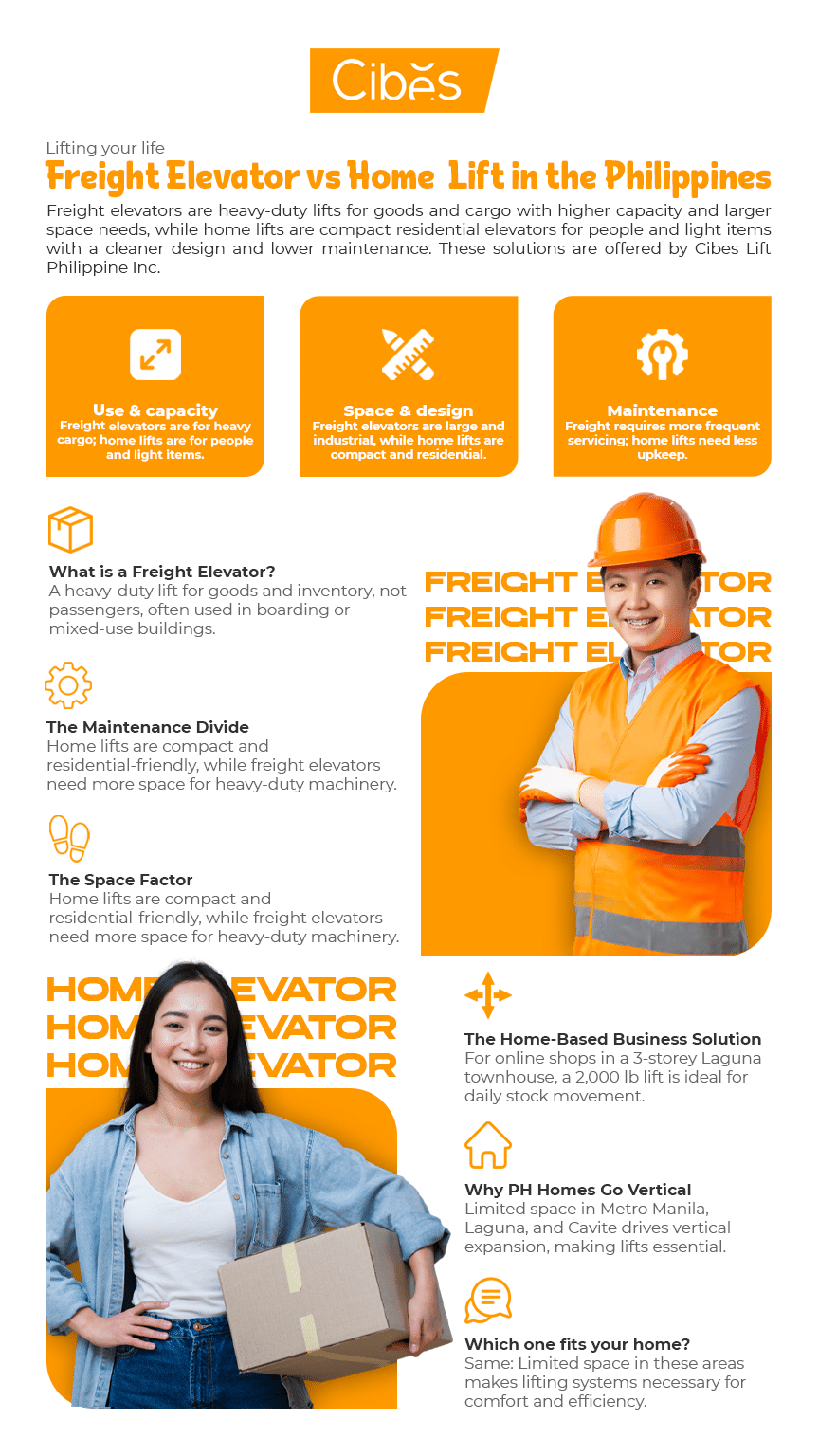
Freight elevator vs home lift: Which is the better choice for your property in the Philippines? A freight elevator is designed primarily to transport heavy goods, while a home lift provides convenient vertical transportation for people, groceries, luggage, and everyday household items. The right option depends on your required load capacity, available installation space, budget, and intended use.
This guide compares freight elevators and home lifts to help Filipino homeowners and small business owners choose the most suitable lifting solution.
Why do many homes in the Philippines need a better lifting solution?
Across Metro Manila, Laguna, and Cavite, homes are often built vertically. Space is limited, so families go up.
That works well, until daily life involves carrying:
- Water gallons
- Bulk groceries
- Online shop inventory
- Furniture or renovation materials
At first, stairs are manageable. Over time, they become tiring and inefficient.
This is where lift solutions come in. But not all homes need a full freight system.
If you’re comparing different residential lift technologies before choosing a system, our Types of Home Lifts in the Philippines Guide explains the main elevator types, their ideal applications, and how freight elevators compare with other home lift solutions.
What’s the difference between a freight elevator and a home lift?
The difference is simple. It comes down to purpose.
| Feature | Freight Elevator | Home Lift (e.g., Cibes Lift) |
|---|---|---|
| Main Use | Heavy cargo | People + daily items |
| Capacity | 1,000–5,000+ lbs | Light to moderate loads |
| Design | Industrial | Residential-friendly |
| Space Needed | Larger | Compact |
| Best For | Business, heavy use | Everyday home living |
Freight elevators are built for constant heavy lifting.
Home lifts, like Cibes Lift, are designed for daily convenience. They carry people comfortably while still handling groceries, luggage, and light cargo.
How do you choose the right freight elevator capacity?
Choosing the right capacity depends on your real daily load, not just occasional use.
| Capacity Tier | Weight Range | Metric | Common Use in PH Homes |
|---|---|---|---|
| Light | 1,000-2,000 lbs | 450-900 kg | Appliances, water containers, furniture |
| Medium | 2,000-4,000 lbs | 900-1,800 kg | Boarding houses, food prep, stock storage |
| Heavy | 4,000+ lbs | 1,800+ kg | Warehousing, construction use |
For most homes with small businesses, 2,000-3,000 lbs is enough.
But here’s the key point.
If you’re not moving heavy loads every day, a Cibes Lift home lift can already handle your needs without the size and cost of a freight system.
When should you install a freight elevator in your home?
A freight elevator makes sense if your home regularly handles:
- Large volumes of inventory or supplies
- Construction materials across floors
- Frequent heavy lifting as part of business operations
- Storage-heavy setups
This is common in:
- Boarding houses
- Mixed-use properties
- Home-based distribution or online selling
When is a home lift a better option than a freight elevator?
Not every home needs industrial-level lifting.
A home lift, like Cibes Lift, is often the better fit if:
- You mainly move people, groceries, and daily items
- Your space is limited (common in townhouses)
- You want a clean, modern look
- Heavy lifting is only occasional
This is where many Filipino homeowners land. They need convenience, not heavy-duty equipment.
What’s the difference between residential and commercial freight elevators?
| Factor | Residential | Commercial |
|---|---|---|
| Usage | Moderate | Daily heavy use |
| Capacity | Medium | High |
| Compliance | Residential standards | Stricter codes |
| Insurance | Home policy update | Business insurance |
| Maintenance | Regular | More frequent |
If your home generates income, even small-scale, this distinction can affect compliance.
How often do freight elevators need maintenance in the Philippines?
Freight elevators typically require:
- 3 to 4 maintenance visits per year
Compared to:
- 1 to 2 visits per year for home lifts like Cibes Lift
Why more frequent?
- Heavier loads increase wear
- Dust and debris build up faster
- Humidity affects components over time
Consistent maintenance keeps the system safe and reliable.
When is a freight elevator NOT the right choice?
A freight elevator may not be ideal if:
- You mainly transport people
- Your home has limited installation space
- Heavy lifting is not part of your routine
- You want a quieter, more residential solution
In many cases, homeowners realize they don’t need a freight system. They need a smarter home upgrade.
Real example: A typical Philippine townhouse setup
A three-storey townhouse in Laguna uses:
- Ground floor for storage
- Upper floors for living
If the homeowner runs an online business, daily box movement makes a freight elevator practical.
But if the need is mostly groceries, luggage, and occasional items, many choose a Cibes Lift lift instead.
It fits the space better and supports everyday living.
Frequently asked questions about freight elevators in the Philippines
Q: What is the weight capacity of a residential freight elevator?
A: Most residential freight elevators in the Philippines carry 1,000 to 3,000 lbs (450–1,360 kg).
Q: How often does a freight elevator need maintenance?
A: Typically 3 to 4 times per year, depending on usage.
Q: Can a freight elevator carry people?
A: Some can, but they must meet different safety standards.
Q: Are freight elevators common in Philippine homes?
A: Yes, especially in homes with businesses, rentals, or heavy storage needs.
Q: Is a home lift enough instead of a freight elevator?
A: For many homes, yes. A Cibes Lift home lift can handle daily use efficiently.
Final thoughts: Which one fits your home?
If your home handles heavy, daily cargo, a freight elevator is the right tool.
But for most Filipino households, the goal is simple. Make daily movement easier.
That’s where a Cibes Lift home elevator often makes more sense. It fits the space, supports daily life, and keeps things simple.
Read More
Experience Center and Technical Station Address
Makati City | Balintawak – Quezon City | Mandaluyong City | Cebu City | Ilo-Ilo City | Davao City | Cagayan De Oro City






CIBES AUTHOR
Mylen Posas is the Aftersales Manager at Cibes Lift Philippines. She oversees aftersales operations, ensuring every customer receives reliable support from installation through long-term maintenance. With a strong focus on service quality and customer satisfaction, she works closely with the technical team to deliver prompt assistance and help maintain the long-term performance and safety of every Cibes home lift.



TL;DR The Cibes Experience Center Visayas in Cebu City lets homeowners, architects, designers, contractors, and developers see Cibes home lifts in person. Visitors can experience the lift cabin, review available designs and features, and discuss installation requirements with the Cibes team. The Cebu Experience Center currently lists V90 Elegance, Z85 Antera, and Ascenda among its […]
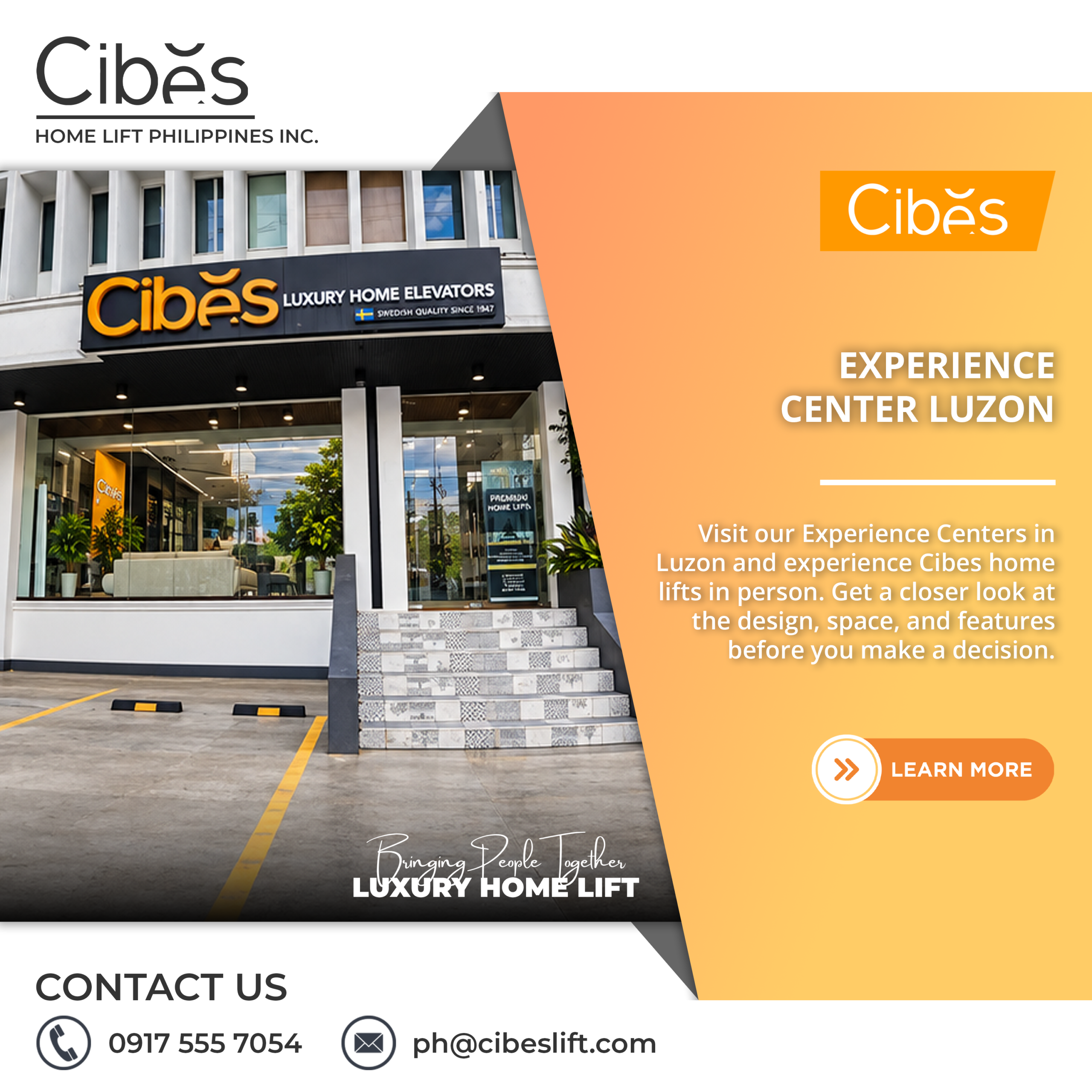
TL;DR Cibes Experience Center Luzon lets homeowners and property professionals experience Cibes home lifts in person before making a decision. Cibes Lift Philippines has 13 demo lifts across three Luzon Experience Centers: Makati (8), Mandaluyong (2), and Balintawak, Quezon City (3). Visitors can ride the lifts, check cabin space, test the controls, explore designs, and […]

TL;DR Sustainable home elevators in the Philippines are becoming an important consideration for homeowners who want to improve accessibility without overlooking environmental responsibility. Modern home elevators can support energy-efficient living through efficient drive systems, durable materials, renewable energy integration, and reduced structural changes compared with major home renovations. The Environmental Case for Sustainable Home Elevators […]

TL;DR Home Elevator Performance plays an important role in the safety, comfort, efficiency, and long-term reliability of a residential lift. While regular maintenance keeps your elevator operating reliably, proper usage, environmental control, component monitoring, electrical optimization, and timely upgrades can further improve its performance. In this guide, discover 8 expert tips to help maximize home […]
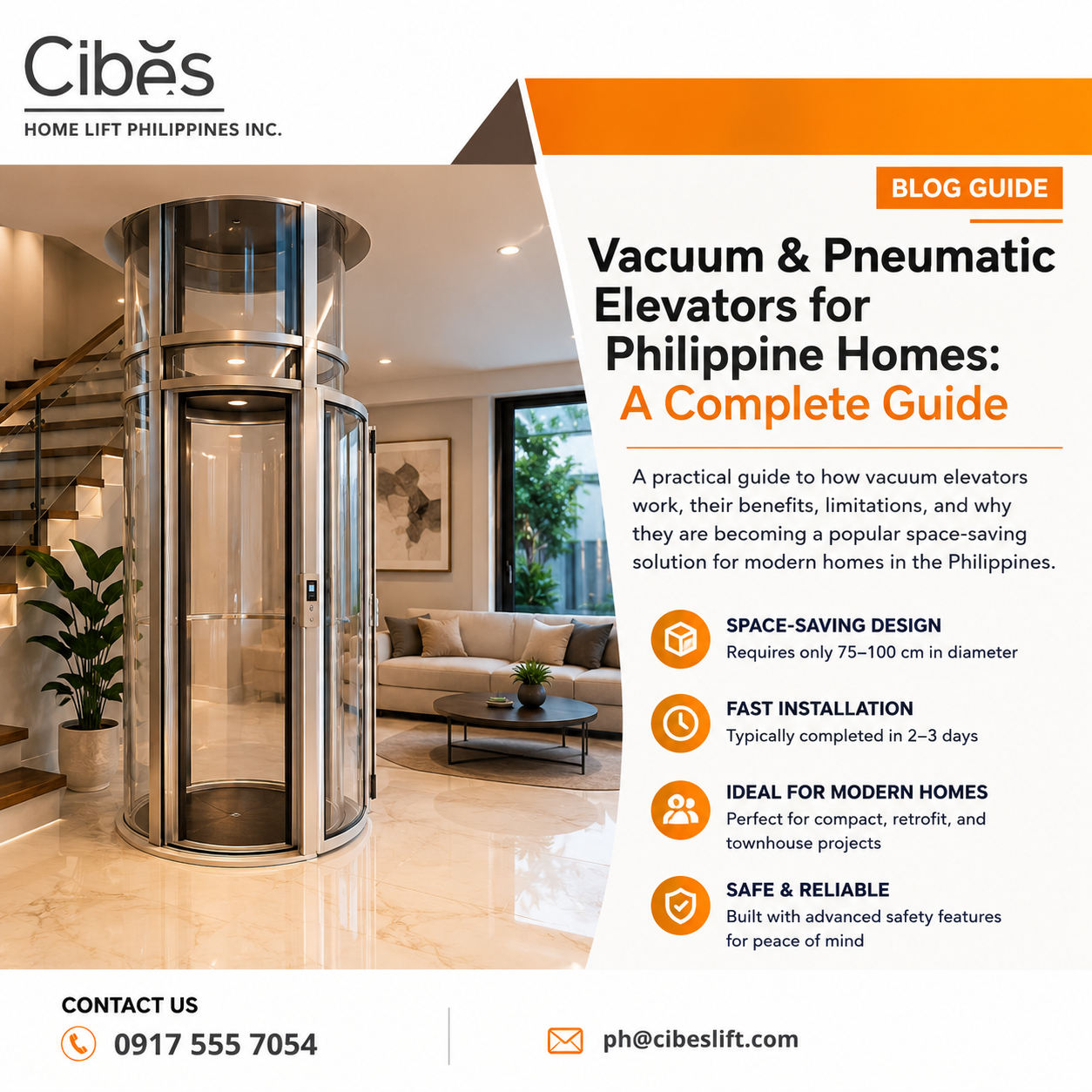
TL;DR Vacuum elevators use air pressure instead of cables or hydraulic systems to move a cabin inside a transparent tube. Most residential models require only 75 to 100 cm of space, serve 2 to 4 floors, carry 205 to 238 kg, and can often be installed in 2 to 3 days with minimal structural work. […]