Blog - 04/09/2026
Home Elevator Price Philippines: Full Breakdown & Comparisons
TL;DR
Home elevator price Philippines can range from ₱1.5M to ₱6M+, depending on the lift system, number of floors, brand, customization, and installation requirements. Most homeowners spend around ₱2.5M to ₱3.5M for a reliable mid-range system in a two- to three-storey home.
Understanding the home elevator price Philippines homeowners can expect means looking beyond the elevator unit itself. Structural work, permits, electrical requirements, finishes, maintenance, and installation complexity can all affect the final cost.
This guide explains the typical home elevator price in the Philippines, compares different system types, and shows what homeowners should consider when planning their budget.
Home Elevator Price Philippines: Quick Price Breakdown
| Category | Price Range | Best For | Typical System |
| Entry-level | ₱1.5M – ₱2.5M | Basic 2-floor use, tight budget | Hydraulic or basic screw-drive |
| Mid-range | ₱2.5M – ₱3.5M | Most homes, long-term use | Screw-drive or traction |
| Premium | ₱3.5M – ₱6.0M+ | Luxury homes, 3+ floors | Traction, smart-home integration |
How Does Home Elevator Price in the Philippines Compare by System and Quality?
Entry-Level Systems (₱1.5M – ₱2.5M)
Entry-level systems cover basic two-floor installations with limited customization and short warranties of one to two years. Service networks are typically smaller. These systems suit straightforward homes but long-term reliability varies, check parts availability and service response times before committing.
Mid-Range Systems (₱2.5M – ₱3.5M)
Mid-range systems use proven screw-drive or traction technology with better finishes, smoother operation, and warranties of two to five years. Local service support is established across major Philippine cities. This is where most homeowners land, it balances cost, comfort, and long-term reliability. Brands like Cibes Lift Philippines sit in this range, serving Metro Manila, Cebu, and Davao.
Premium Systems (₱3.5M – ₱6.0M+)
Premium systems are designed for three or more floors, larger cabins, high-end glass or custom interiors, and smart building integration. Full-service contracts are standard. Global brands such as Otis, Schindler, and KONE operate in this tier. Note: global premium brands often carry longer lead times for parts compared to locally-stocked alternatives.
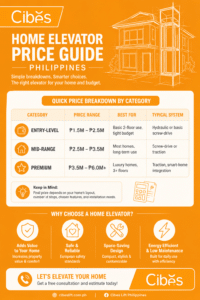
Thinking about installing a home elevator in the Philippines? Here’s a quick and easy pricing guide from Cibes. Compare entry-level, mid-range, and premium home lift options to find the right fit for your home, lifestyle, and budget
How to Choose the Right Budget Tier for Your Home
Choosing the right budget tier depends on three variables: your home’s floor count, your timeline (new build vs. retrofit), and your tolerance for ongoing service costs. Mid-range systems (₱2.5M- ₱3.5M) deliver the best cost-per-year-of-service ratio for most Filipino homes because their screw-drive or traction technology requires fewer oil changes than hydraulic alternatives and their local service networks are established in Metro Manila, Cebu, and Davao. If you are retrofitting into an existing staircase, factor in ₱100,000- ₱300,000 in structural work that most online quotes exclude. Premium systems are worth the extra investment only when you need three or more floors, large cabins, or smart-home integration.
How Much Does a Home Elevator Cost by Number of Floors?
| Floors | Entry-Level | Mid-Range | Premium |
| 2 floors | ₱1.5M – ₱2.5M | ₱2.5M – ₱3.2M | ₱3.5M – ₱4.5M |
| 3 floors | ₱2.5M+ | ₱3M | ₱4.5M – ₱6M+ |
| 4+ floors | ₱3.0M+ | ₱3.5M+ | ₱6M+ |
More floors mean higher costs due to structure, travel height, and installation time.
The home elevator price Philippines homeowners pay can increase with additional floors because travel height, structural work, and installation requirements also increase.
How Do Prices Vary by Brand in the Philippines?
Brand selection can also affect the home elevator price Philippines market, particularly when comparing local service support, technology, warranty coverage, and available customization.
Cibes Lift Philippines
2-storey: ₱2.5M – ₱3.5M | 3-storey: ₱2.5M – ₱4.2M
Screw-drive, shaftless designs require no machine room, with local service teams in Metro Manila. Documented project installs across Quezon City, Cavite, Batangas, and Davao.
Global Premium Brands (Otis, Schindler, KONE)
Typical range: ₱3M – ₱6M+. Best for large homes or luxury builds where full-service contracts and smart integration are required.
Entry-Level Manufacturers
Often Asian-origin brands at ₱1.5M – ₱2.5M. Lower upfront cost, but verify service coverage, parts availability, and warranty terms carefully.
What’s Included in the Price?
Most home elevator packages include the elevator unit, installation labor, standard cabin finishes, and mandatory safety features (overload sensor, emergency stop, door safety edges).
Costs typically excluded from quotes:
- Structural shaft or pit construction (₱100,000- ₱300,000)+-
- Electrical panel upgrades
- Permit and inspection fees (varies by LGU)
- Custom finish upgrades
Always request an itemized quote that separates equipment cost from civil works.
How Much Does It Cost to Run a Home Elevator?
Electricity costs for residential elevators in the Philippines typically range from ₱500+- to ₱1,500+- per month based on daily trip frequency and system type. Screw-drive systems generally consume less power per trip than hydraulic systems because they do not run a continuous pump motor.
Annual maintenance contracts typically cost ₱15,000+- – ₱40,000+- depending on brand and coverage tier.
How Can You Reduce Home Elevator Costs?
- Install during new construction rather than retrofit (saves ₱80,000 +- – ₱200,000+- in civil works)
- Choose standard cabin sizes (around 1.0m x 1.2m works for most homes)
- Limit custom finishes at first install; upgrade later
- Compare multiple suppliers with itemized quotes
- Ask about financing or staged upgrades
Cutting price too much upfront can lead to higher maintenance costs and limited service support later.
How Much Should You Budget?
Recommended Budget for Most Filipino Homes
₱2.5M to ₱3.5M covers a dependable system with good comfort, safety, and long-term value.
Is a Home Elevator Worth It?
For multi-storey Filipino homes, a home elevator improves daily comfort, supports aging family members and PWD household members, and adds measurable resale value. It is a long-term infrastructure investment, not a luxury convenience.
Frequently Asked Questions
Q: How much does a home elevator cost in the Philippines?
A: The home elevator price Philippines range is typically around ₱1.5M to ₱6M+, depending on the system type, number of floors, brand, customization, and installation requirements.
Q: What is the average price for a home elevator in the Philippines?
A: Most installs fall between ₱2.5M and ₱3.5M.
Q: Why do home elevator prices vary so much?
A: The main factors are number of floors, customization level, brand, and installation complexity. Retrofit installs also add civil works costs (₱100,000+- – ₱300,000+-) that quotes often exclude.
Q: Which home elevator brand offers good value in the Philippines?
A: Mid-range brands like Cibes Lift Philippines are often chosen for their balance of technology, local service, and documented project track record.
Q:Can I install a home elevator on a tight budget?
A: Yes, but prioritize safety features, warranty length, and local service coverage. A lower upfront price can result in higher long-term maintenance costs.
Q: What is included in a home elevator quote?
A: A complete quote should include the elevator unit, installation labor, standard finishes, and safety systems. Structural work, permits, and electrical upgrades are usually quoted separately.
Q: How long does home elevator installation take in the Philippines?
A: Typical is more or less 10-15 days for the lift unit, plus civil works lead time.
Learn more
- How Much Does a Home Elevator Cost in The Philippines? Comparison of 5 Kinds of Home Lifts and Price
- Explore Small & Affordable Elevator Options
Experience Center and Technical Station Address
Makati City | Balintawak – Quezon City | Mandaluyong City | Cebu City | Ilo-Ilo City | Davao City | Cagayan De Oro City






CIBES AUTHOR
Mylen Posas is the Aftersales Manager at Cibes Lift Philippines. She oversees aftersales operations, ensuring every customer receives reliable support from installation through long-term maintenance. With a strong focus on service quality and customer satisfaction, she works closely with the technical team to deliver prompt assistance and help maintain the long-term performance and safety of every Cibes home lift.



TL;DR The Cibes Experience Center Visayas in Cebu City lets homeowners, architects, designers, contractors, and developers see Cibes home lifts in person. Visitors can experience the lift cabin, review available designs and features, and discuss installation requirements with the Cibes team. The Cebu Experience Center currently lists V90 Elegance, Z85 Antera, and Ascenda among its […]
TL;DR Cibes Experience Center Luzon lets homeowners and property professionals experience Cibes home lifts in person before making a decision. Cibes Lift Philippines has 13 demo lifts across three Luzon Experience Centers: Makati (8), Mandaluyong (2), and Balintawak, Quezon City (3). Visitors can ride the lifts, check cabin space, test the controls, explore designs, and […]

TL;DR Sustainable home elevators in the Philippines are becoming an important consideration for homeowners who want to improve accessibility without overlooking environmental responsibility. Modern home elevators can support energy-efficient living through efficient drive systems, durable materials, renewable energy integration, and reduced structural changes compared with major home renovations. The Environmental Case for Sustainable Home Elevators […]

TL;DR Home Elevator Performance plays an important role in the safety, comfort, efficiency, and long-term reliability of a residential lift. While regular maintenance keeps your elevator operating reliably, proper usage, environmental control, component monitoring, electrical optimization, and timely upgrades can further improve its performance. In this guide, discover 8 expert tips to help maximize home […]

TL;DR Vacuum elevators use air pressure instead of cables or hydraulic systems to move a cabin inside a transparent tube. Most residential models require only 75 to 100 cm of space, serve 2 to 4 floors, carry 205 to 238 kg, and can often be installed in 2 to 3 days with minimal structural work. […]