Blog - 11/08/2026
Why Home Lifts Are Becoming More Popular in Renovation Projects
TL;DR
Filipino homeowners are increasingly installing home lifts during renovation projects because renovations provide easier structural access, lower installation disruption, improved accessibility, and long-term property value benefits. For many two-storey and three-storey homes, renovating is often the most practical and cost-effective time to add a lift while preparing the property for future needs.
Across Metro Manila, Cebu, Davao, and other growing residential areas, homeowners are no longer viewing home lifts as luxury additions reserved for large mansions. Instead, they are becoming a practical feature for families planning to stay in their homes for decades.
Whether the goal is improving accessibility, supporting elder family members, or increasing long-term property appeal, renovation projects create an ideal opportunity to integrate a home lift into an existing house.
Why Is Renovation the Best Time to Install a Home Lift?
Renovation projects naturally involve structural modifications, making it easier to integrate a home lift into the home’s layout.
During a renovation, contractors already have access to walls, floor openings, stairwells, and utility areas. This reduces the need for additional demolition work later and allows lift installation to be planned alongside other upgrades.
Many homeowners choose to install a lift when:
- Expanding from two to three storeys
- Redesigning staircases
- Converting atrium spaces
- Modernizing older family homes
- Renovating inherited properties
Because contractors, equipment, and materials are already on-site, installation can often be coordinated more efficiently than scheduling a completely separate project years later.
Renovation vs. Post-Renovation Installation
| Factor | During Renovation | After Renovation |
|---|---|---|
| Structural modifications | Easier to coordinate | May require additional demolition |
| Layout planning | Greater flexibility | Limited by completed design |
| Contractor scheduling | Integrated into project | Separate project required |
| Permit coordination | Often processed together | Additional approvals may be needed |
| Household disruption | Usually lower overall | Separate construction period |
For many homeowners, this makes renovation the most logical time to future-proof a multi-storey home.
Why Are Filipino Homeowners Planning for Accessibility Earlier?
Accessibility has become a much bigger consideration than it was ten years ago.
Many Filipino homeowners renovating today are in their 50s and 60s. While stairs may not be difficult today, many families are planning for how their homes will function twenty or thirty years from now.
A growing number of households are asking a simple question:
Will this home still be comfortable when we are 75 or 85 years old?
Planning ahead often costs less than making major accessibility modifications later.
Installing a home lift during renovation allows homeowners to address future mobility needs before they become urgent.
This approach supports aging in place, allowing homeowners to remain in the homes they love while maintaining independence and comfort.
For a deeper look at aging in place and accessibility planning, see our guide on Home Lifts for Multi-Generational Homes.
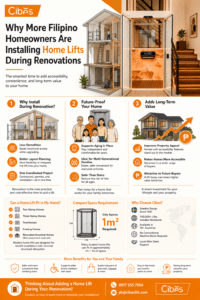
Discover why more Filipino homeowners are adding home lifts during renovations. Learn how home lifts improve accessibility, support multi-generational living, increase property value, and fit into compact spaces with minimal structural disruption. Explore the benefits of installing a Cibes home lift while renovating your home.
Why Are Multi-Generational Filipino Homes Driving Demand for Home Lifts?
The Philippines has a strong tradition of multi-generational living.
In many households, grandparents, parents, and children share the same property. While this arrangement strengthens family connections, it can also create accessibility challenges when homes have multiple floors.
A home lift helps family members move safely between levels regardless of age or mobility.
Benefits for multi-generational households include:
- Easier access for family members
- Improved safety compared to stairs
- Greater independence for family members with mobility limitations
- More convenient transport of groceries, luggage, and household items
- Long-term flexibility as family needs evolve
Rather than relocating to a bungalow or assisted living facility, many Filipino families choose to adapt their existing homes to support future generations.
Do Home Lifts Increase Property Value in the Philippines?
Many homeowners view a home lift as an investment in both lifestyle and property value.
Properties with built-in accessibility features often appeal to a broader range of buyers, particularly families looking for long-term convenience.
Potential buyers may include:
| Buyer Type | Why They Value a Home Lift |
|---|---|
| Growing families | Future-proof accessibility |
| Multi-generational households | Easier movement between floors |
| Older homeowners | Improved safety and convenience |
| Long-term investors | Enhanced market appeal |
While the exact impact varies depending on location and property type, accessibility features can help a home stand out in competitive residential markets.
For many buyers, a home that already includes a lift eliminates the need for costly upgrades later.
Can a Home Lift Be Installed in an Existing House in the Philippines?
Yes.
Modern home lifts are specifically designed for retrofit installations and can often be integrated into existing homes with minimal structural disruption.
Unlike traditional commercial elevators that typically require large shafts and machine rooms, many modern residential lifts are designed with a much smaller footprint.
Home lifts can often be installed in:
| Home Type | Suitable for Lift Installation |
|---|---|
| Two-storey homes | Yes |
| Three-storey homes | Yes |
| Townhouses | Yes |
| Multi-generational homes | Yes |
| Renovated ancestral homes | Site assessment required |
Many homeowners are surprised to learn that some lift systems can fit into surprisingly compact spaces.
To learn more about installation requirements, visit our Complete Guide to Home Elevator Installation.
How Much Space Does a Home Lift Require?
Space requirements vary depending on the lift model.
Compact residential lifts can often be installed in spaces as small as approximately one square meter, making them suitable for many Philippine homes. Some modern systems also eliminate the need for a conventional machine room, reducing construction requirements further.
The ideal location depends on the home’s layout, floor plan, and renovation scope.
Common installation locations include:
- Existing stairwell openings
- Central atriums
- Adjacent wall spaces
- New home extensions
- Converted storage areas
A professional site assessment is always recommended before selecting a lift model.
How Do You Add a Home Lift During a Renovation?
The process is generally straightforward when included during renovation planning.
Step 1: Assess Available Space
Evaluate potential lift locations and determine how the lift will integrate into the home’s layout.
Step 2: Consult a Home Lift Specialist
A specialist can recommend suitable models, dimensions, and installation requirements.
Step 3: Coordinate Structural Planning
Architects and contractors can incorporate lift requirements into renovation drawings and construction schedules.
Step 4: Secure Approvals
Permit requirements vary depending on location and project scope.
Step 5: Installation and Commissioning
The lift is installed, tested, and prepared for daily operation.
Planning early in the renovation process usually results in a smoother installation experience.
What Should You Look for in a Home Lift for Renovation Projects?
Not all home lifts are designed for retrofit applications.
When evaluating options, homeowners should consider:
- Compact footprint
- Minimal structural requirements
- Energy efficiency
- Safety certifications
- Reliability and after-sales support
- Design flexibility
- Long-term maintenance support
Homes in the Philippines should also consider tropical climate conditions, including humidity, heat, and occasional power interruptions.
For more guidance, read Home Lift Features That Matter Most in Tropical Philippine Homes.
Why Many Renovating Homeowners Choose Cibes Home Lifts
Choosing the right lift provider is just as important as selecting the right model.
Founded in Sweden in 1947, Cibes Lift Group has installed more than 100,000 lifts across over 70 countries worldwide. In the Philippines, Cibes has been helping homeowners improve accessibility since 2015.
Cibes home lifts are designed with:
- Compact footprints
- Space-efficient installation
- Scandinavian design
- No conventional machine room requirement
- Strong local after-sales support
These features make them particularly suitable for renovation projects where available space and installation flexibility are important considerations.
Whether upgrading a townhouse in Metro Manila, a family home in Cebu, or a provincial residence, installing a home lift during renovation can improve daily convenience while preparing the home for future accessibility needs.
Frequently Asked Questions
Q: Is renovation the best time to install a home lift?
A: In most cases, yes. Renovation projects provide easier access to structural areas and allow lift installation to be coordinated with other construction work.
Q: Can a home lift be installed in an existing house?
A: Yes. Many modern residential lifts are specifically designed for retrofit installations.
Q: How much space does a home lift require?
A: Requirements vary by model, but some compact systems can fit within approximately one square meter of floor space.
Q: How long does installation take?
A: Installation timelines vary depending on the project, but many residential lift installations can be completed within a few weeks once site preparation is finished.
Q: Do home lifts increase property value?
A: A home lift can improve market appeal by making a property more accessible and attractive to long-term buyers.
Q: Are home lifts suitable for multi-generational Filipino households?
A: Yes. Home lifts help family members of all ages move comfortably and safely between floors.
Q: Can a home lift be installed without a machine room?
A: Many modern residential lift systems do not require a conventional machine room, making them ideal for renovation projects.
What type of home lift is best for renovations?
A: Compact residential lifts designed for retrofit installations are generally the most suitable choice for renovation projects.
Learn more:
- Why More Filipino Families Are Choosing Home Lifts in Multi-Generational Homes
- What Not to Expect When Installing a Home Lift
- Complete Guide to Home Elevator Installation in the Philippines (Size, Cost & Requirements)
- Retrofitting a Compact Home Lift in Small Homes: Step-by-Step Guide for Tight Spaces
Experience Center and Technical Station Address
Makati City | Balintawak – Quezon City | Mandaluyong City | Cebu City | Ilo-Ilo City | Davao City | Cagayan De Oro City






CIBES AUTHOR
Mylen Posas is the Aftersales Manager at Cibes Lift Philippines. She oversees aftersales operations, ensuring every customer receives reliable support from installation through long-term maintenance. With a strong focus on service quality and customer satisfaction, she works closely with the technical team to deliver prompt assistance and help maintain the long-term performance and safety of every Cibes home lift.



TL;DR Outdoor home elevators can improve accessibility while preserving valuable indoor space. In the Philippines, proper weather protection, structural engineering, drainage, and installation planning are essential. This guide explores installation considerations, safety requirements, potential costs, and what homeowners should know before choosing an outdoor home lift. Outdoor elevator installations can help homeowners in the Philippines […]

TL;DR The Cibes Experience Center Mindanao locations in Davao City and Cagayan de Oro City let homeowners, architects, contractors, and property developers explore home lift solutions in person. Compare available designs, check finishes, and discuss your property requirements with the Cibes team. Contact your preferred showroom before visiting to confirm operating hours and available demo […]

TL;DR The Cibes Experience Center Visayas in Cebu City lets homeowners, architects, designers, contractors, and developers see Cibes home lifts in person. Visitors can experience the lift cabin, review available designs and features, and discuss installation requirements with the Cibes team. The Cebu Experience Center currently lists V90 Elegance, Z85 Antera, and Ascenda among its […]

TL;DR Cibes Experience Center Luzon lets homeowners and property professionals experience Cibes home lifts in person before making a decision. Cibes Lift Philippines has 13 demo lifts across three Luzon Experience Centers: Makati (8), Mandaluyong (2), and Balintawak, Quezon City (3). Visitors can ride the lifts, check cabin space, test the controls, explore designs, and […]

TL;DR Sustainable home elevators in the Philippines are becoming an important consideration for homeowners who want to improve accessibility without overlooking environmental responsibility. Modern home elevators can support energy-efficient living through efficient drive systems, durable materials, renewable energy integration, and reduced structural changes compared with major home renovations. The Environmental Case for Sustainable Home Elevators […]