Blog - 07/08/2026
Traction Elevators: The Premium Choice for Philippine Homes
TL;DR
Traction elevators Philippines homeowners consider offer smooth operation, energy efficiency, and reliable vertical transportation for multi-storey homes. But are they the right choice for your property? Learn how traction elevators work, their key benefits, and how they compare with other residential lift systems.
If you’re comparing different residential lift technologies before choosing a system, our Types of Home Lifts in the Philippines Guide explains the main elevator types, how they work, and which solutions are best suited for different homes, budgets, and mobility needs.
What Is a Traction Elevator and How Does It Work?
A traction elevator moves using steel wire ropes and a motor-driven pulley system.
The elevator car attaches to one side of the ropes, while a counterweight balances the load on the opposite side. When the motor rotates the pulley, the ropes move and lift the car between floors.
Most modern residential traction elevators use gearless motors. The motor connects directly to the pulley without gears, reducing friction and improving efficiency.
This design creates a smooth and quiet ride, which is why traction elevators are widely used in modern residential buildings.
Main components of a traction elevator
| Component | Function |
| Electric motor | Drives the lifting system |
| Steel wire ropes | Lift and lower the elevator car |
| Grooved pulley | Transfers motion from the motor |
| Counterweight | Balances the elevator load |
| Elevator car | Carries passengers |
The system provides stable movement, long lifespan, and energy-efficient operation.
Why Are Traction Elevators Suitable for Philippine Homes?
Several local factors make traction elevators particularly practical for Filipino households.
Electricity costs in the Philippines
Electricity prices in the Philippines are among the highest in Southeast Asia. Traction elevators consume 40- 70% less electricity than hydraulic elevators, which helps reduce long-term operating costs.
Some homeowners compare the energy use of a residential traction elevator to that of a household appliance such as a refrigerator.
Multi-storey residential design
In cities like Metro Manila and Cebu, land prices continue to rise. Many homes are designed vertically, with three or more floors.
Traction elevators work especially well in these layouts because they provide faster movement between floors.
Quiet operation
Filipino homes often have closely spaced living areas. Traction elevators operate quietly, helping reduce disturbance to nearby rooms.
Long service life
With proper maintenance, traction elevators can operate for 25-30 years or more.
This long lifespan is helpful for families planning long-term residence or multi-generational homes.
How Do Traction Elevators Compare with Hydraulic Elevators and Cibes Home Lifts?
Homeowners in the Philippines often compare traction elevators, hydraulic elevators, and compact home lifts such as Cibes lifts before choosing a residential elevator.
Each system offers different advantages depending on the home layout, available space, and design priorities.
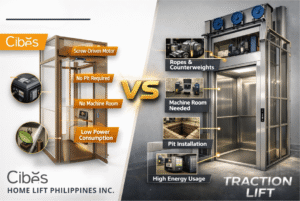
| Feature | Traction Elevator | Hydraulic Elevator | Cibes Home Lift |
| Drive system | Motor with ropes and counterweight | Hydraulic piston | Screw-driven lift |
| Energy consumption | 40–70% lower than hydraulic | Higher electricity use | Low energy consumption |
| Machine room | Sometimes required | Often required | Not required |
| Space requirements | Moderate shaft space | Larger equipment space | Compact footprint |
| Ride quality | Smooth and quiet | Smooth but slower | Smooth residential ride |
| Ideal homes | 3+ storey houses | Low-rise buildings | Homes with limited space |
| Design flexibility | Standard elevator layouts | Structural constraints | Flexible installation |
| Lifespan | 25–30+ years | Typically shorter | Long service life |
Traction elevators are usually preferred in taller residential buildings.
However, Cibes home lifts offer strong advantages in homes where space efficiency and architectural design are priorities. Because they use a compact screw-driven system and do not require a traditional machine room, they can often fit into smaller areas or existing homes.
Traction Elevators Philippines: Benefits for Modern Homes
Traction elevators work best in certain residential layouts.
Multi-storey family homes
Many houses in Metro Manila subdivisions and Cebu residential areas now have three or four floors. A home elevator helps make daily movement between floors easier.
Elevated homes in flood-prone areas
Some Philippine homes are designed with raised living floors to reduce flood risk. Vertical layouts like this benefit from residential elevators.
Large residential properties
Traction elevators work well in houses where shaft space is available and long-term durability is important.
When Might a Cibes Home Lift Be a Better Option?
A Cibes home lift can be a strong alternative when space or design flexibility is important.
These lifts are often chosen when:
- Installation space is limited
- The project is a home renovation
- Minimal structural modification is preferred
- The homeowner prioritizes compact design
Because Cibes lifts use a self-supporting screw-driven system, they can sometimes be installed in areas where traditional elevator shafts would be difficult.
Are Traction Elevators Reliable in the Philippine Climate?
Yes. Modern traction elevators are designed to operate in humid tropical environments.
Their mechanical components are usually enclosed, helping protect them from humidity, heat, and seasonal weather conditions.
Typical maintenance schedule
| Maintenance task | Frequency |
| Professional inspection | 1–2 times per year |
| Safety system checks | During servicing |
| System adjustments | as required |
With proper maintenance, traction elevators can operate reliably for decades in Philippine conditions.
Many elevator providers also maintain service networks in Metro Manila and other major Philippine cities, which supports long-term reliability.
Traction Elevator FAQs for Philippine Homeowners
Q: Are traction elevators suitable for homes in the Philippines?
Yes. Traction elevators are commonly installed in multi-storey homes and townhouses in cities such as Metro Manila and Cebu.
Q: How much electricity does a traction home elevator use?
A: Traction elevators use significantly less electricity than hydraulic elevators, helping reduce operating costs in the Philippines where power prices are relatively high.
Q: Are traction elevators reliable in tropical climates?
A: Yes. Modern traction elevators are designed for humid and warm environments. With regular servicing, they can operate for 25–30 years or more.
Q: How many floors can a traction home elevator serve?
A: Traction elevators are especially beneficial in homes with three or more floors, where faster travel and smoother operation are noticeable.
Q: How often should a traction elevator be serviced?
A: Most residential traction elevators require professional servicing once or twice per year.
Q: Can traction elevators work with solar-powered homes?
A: Yes. Because traction elevators consume relatively little electricity, they can operate efficiently with residential solar power systems.
Final Thoughts
Residential elevators are becoming more common as Philippine homes grow vertically. Traction elevators offer energy efficiency, quiet operation, and long service life, making them suitable for many multi-storey houses.
At the same time, compact systems such as Cibes home lifts provide a flexible alternative when space, renovation constraints, or architectural design are key considerations.
Choosing the right system depends on the home layout, available space, and long-term mobility needs of the household.
Read More
Experience Center and Technical Station Address
Makati City | Balintawak – Quezon City | Mandaluyong City | Cebu City | Ilo-Ilo City | Davao City | Cagayan De Oro City






CIBES AUTHOR
Mylen Posas is the Aftersales Manager at Cibes Lift Philippines. She oversees aftersales operations, ensuring every customer receives reliable support from installation through long-term maintenance. With a strong focus on service quality and customer satisfaction, she works closely with the technical team to deliver prompt assistance and help maintain the long-term performance and safety of every Cibes home lift.


TL;DR The Cibes Experience Center Visayas in Cebu City lets homeowners, architects, designers, contractors, and developers see Cibes home lifts in person. Visitors can experience the lift cabin, review available designs and features, and discuss installation requirements with the Cibes team. The Cebu Experience Center currently lists V90 Elegance, Z85 Antera, and Ascenda among its […]
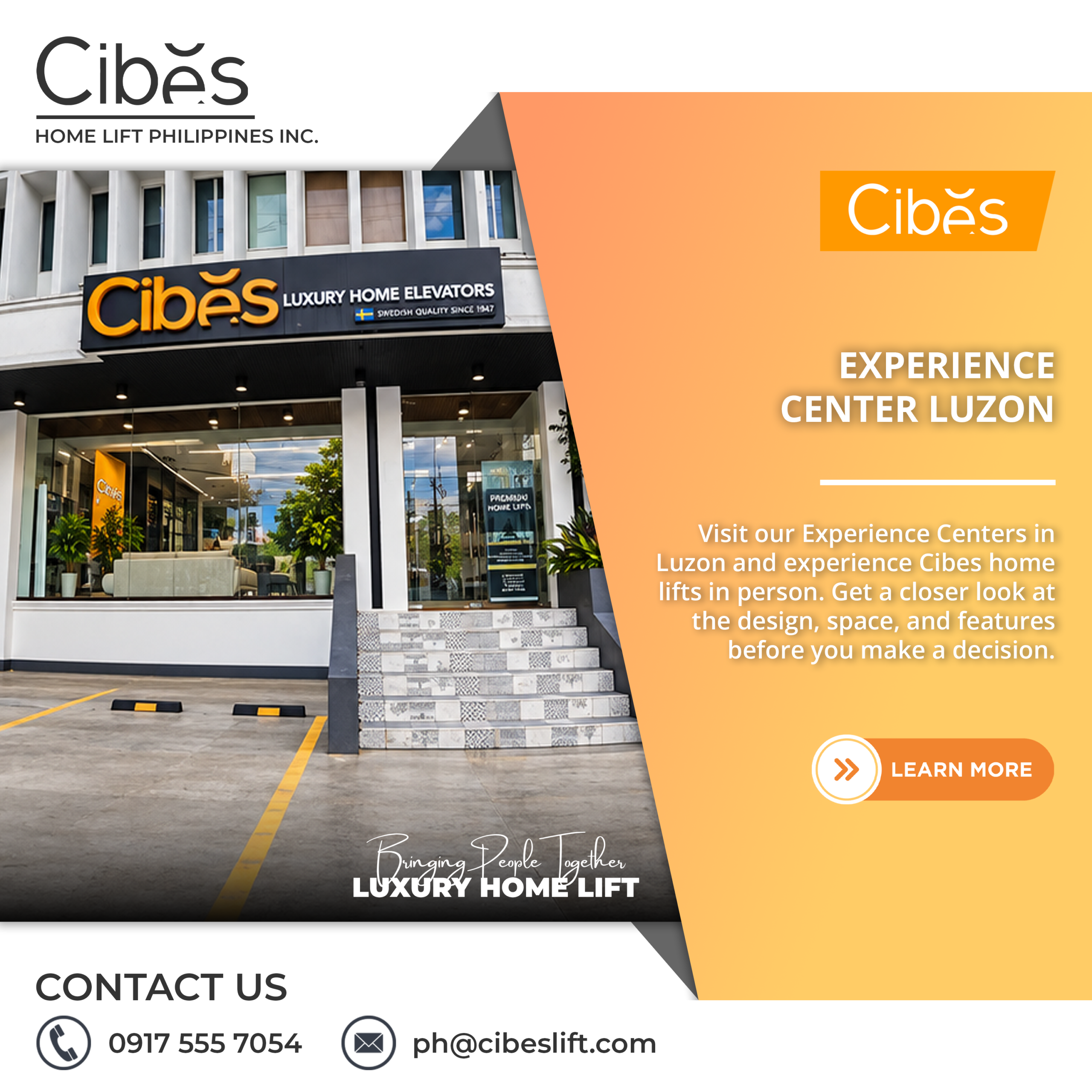
TL;DR Cibes Experience Center Luzon lets homeowners and property professionals experience Cibes home lifts in person before making a decision. Cibes Lift Philippines has 13 demo lifts across three Luzon Experience Centers: Makati (8), Mandaluyong (2), and Balintawak, Quezon City (3). Visitors can ride the lifts, check cabin space, test the controls, explore designs, and […]

TL;DR Sustainable home elevators in the Philippines are becoming an important consideration for homeowners who want to improve accessibility without overlooking environmental responsibility. Modern home elevators can support energy-efficient living through efficient drive systems, durable materials, renewable energy integration, and reduced structural changes compared with major home renovations. The Environmental Case for Sustainable Home Elevators […]

TL;DR Home Elevator Performance plays an important role in the safety, comfort, efficiency, and long-term reliability of a residential lift. While regular maintenance keeps your elevator operating reliably, proper usage, environmental control, component monitoring, electrical optimization, and timely upgrades can further improve its performance. In this guide, discover 8 expert tips to help maximize home […]
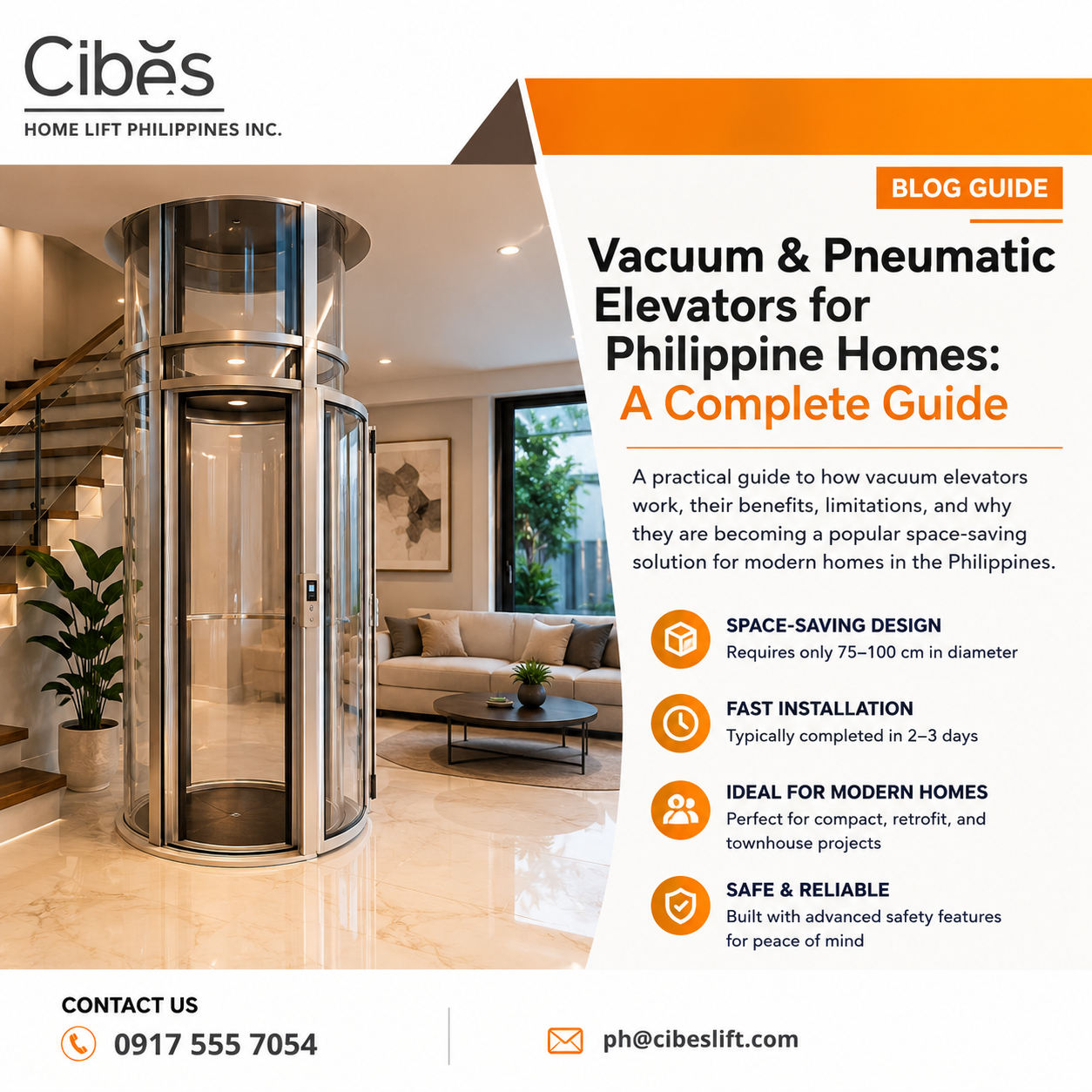
TL;DR Vacuum elevators use air pressure instead of cables or hydraulic systems to move a cabin inside a transparent tube. Most residential models require only 75 to 100 cm of space, serve 2 to 4 floors, carry 205 to 238 kg, and can often be installed in 2 to 3 days with minimal structural work. […]