Blog - 25/09/2026
Vacuum & Pneumatic Elevators :The Futuristic Home Lift Solution
TL;DR
Vacuum elevators use air pressure instead of cables or hydraulic systems to move a cabin inside a transparent tube. Most residential models require only 75 to 100 cm of space, serve 2 to 4 floors, carry 205 to 238 kg, and can often be installed in 2 to 3 days with minimal structural work.
In the Philippines, vacuum and pneumatic elevators are becoming more common in modern townhouses, retrofit homes, beach properties, and compact urban residences where traditional elevator shafts are difficult to build.
Unlike conventional residential elevators, pneumatic systems use a self-supporting tube structure. This reduces construction requirements and makes installation easier for existing homes in Metro Manila, Cebu, Davao, Batangas, and other growing residential areas.
For Filipino homeowners planning long-term accessibility upgrades, aging-in-place renovations, or space-saving home improvements, vacuum elevators offer a practical alternative to traditional lift systems.
If you’re comparing different residential lift technologies before choosing a system, our Types of Home Lifts in the Philippines Guide explains the main elevator types, how they work, and which solutions are best suited for different homes, budgets, and space requirements.
How Do Vacuum Elevators Work?
Vacuum elevators use controlled air pressure differences to move the cabin between floors. Instead of relying on cables, pulleys, or hydraulic systems, pneumatic elevators use turbines positioned at the top of the structure.
When the turbines create lower air pressure above the cabin, atmospheric pressure below pushes the cabin upward. To descend, the system gradually equalizes air pressure, allowing the cabin to move down smoothly and safely.
The elevator travels inside a transparent polycarbonate tube that also serves as the elevator shaft. Because the structure is self-supporting, most residential installations do not require a separate shaft or machine room.
This simplified system reduces structural requirements while maintaining reliable residential performance.
Why Vacuum Elevators Suit Philippine Homes
Many homes in the Philippines were not originally designed for elevators. This is especially true for older residences, compact townhouses, and urban homes built on smaller lots.
Traditional residential elevators often require:
- reinforced shafts
- dedicated machine rooms
- deeper pits
- extensive structural modifications
Vacuum elevators reduce many of these requirements.
Most installations can be completed in around 2 to 3 days with limited construction work. For homeowners in Metro Manila, Quezon City, Cebu, and Davao looking to upgrade accessibility without major renovation, this can be a significant advantage.
Space efficiency is another reason vacuum elevators are gaining attention in the Philippine residential market. Standard residential units generally require only 75 to 100 cm in diameter, making them suitable for:
- compact homes
- duplexes
- retrofit projects
- multi-storey townhouses
- modern minimalist residences
For homes where every square meter matters, smaller lift footprints can make installation more feasible.
Vacuum Elevator Specifications for Residential Homes
| Specification | Typical Residential Range |
| Diameter | 75 to 100 cm |
| Capacity | 205 to 238 kg |
| Passenger Capacity | 2 to 3 people |
| Floors Served | 2 to 4 floors |
| Installation Time | Around 2 to 3 days |
| Speed | 4.5 to 9 meters per minute |
| Drive System | Air pressure / pneumatic |
Specifications vary depending on the elevator model and installation conditions.
Where Do Vacuum Elevators Work Best in Philippine Homes?
Vacuum elevators are particularly suitable for certain residential situations commonly found in the Philippines.
Existing Homes and Retrofit Projects
Older Filipino homes often lack the structural provisions required for conventional elevators. Because pneumatic systems require less construction work, they are commonly considered for retrofit accessibility upgrades.
This makes them practical for:
- aging-in-place renovations
- multi-generational homes
- accessibility improvements
- residential upgrades without major reconstruction
Compact Urban Homes
In dense residential areas where lot sizes are limited, installing a traditional lift can be difficult.
Vacuum elevators can fit into tighter interior layouts, making them suitable for:
- small urban homes
- narrow townhouses
- compact residential developments
- vertical homes in Metro Manila and nearby cities
Modern and Contemporary Houses
The transparent tube design works well with modern architectural styles that emphasize open layouts, glass, and minimalism.
Many homeowners also prefer the visible mechanical operation because it adds a more contemporary appearance compared to enclosed elevator systems.
Coastal and Beach Properties
Vacuum elevators are also considered for coastal homes in areas like:
- Batangas
- Palawan
- Cebu
- La Union
- Subic
Many pneumatic systems use polycarbonate and aluminum components instead of exposed steel cable systems. This may help reduce concerns related to salt-air corrosion in seaside environments.
Vacuum Elevator vs Traditional Residential Elevator
| Feature | Vacuum Elevator | Traditional Residential Elevator |
| Shaft Requirement | No separate shaft required | Requires constructed shaft |
| Machine Room | Usually not required | Often required |
| Installation Time | Around 2 to 3 days | Several weeks |
| Space Requirement | About 75 to 100 cm diameter | Larger footprint |
| Typical Floors | 2 to 4 floors | Higher travel possible |
| Capacity | 205 to 238 kg | Higher load capacity |
| Best Use Case | Compact homes and retrofits | Large homes and heavy usage |
Limitations of Vacuum Elevators in Philippine Homes
Vacuum elevators are not ideal for every residential situation. Understanding their limitations is important before planning installation.
| Limitation | Details |
| Height Limits | Most residential models serve 2 to 4 floors up to around 13.5 meters |
| Capacity Limits | Standard units usually carry 2 to 3 people |
| Moderate Speed | Travel speed is generally slower than traditional elevators |
| Transparent Design | Some homeowners may prefer enclosed cabins for privacy |
For most 2- to 3-storey Philippine homes, these limitations are usually manageable. However, larger residences or high-capacity requirements may still be better suited for conventional elevator systems.
Is a Vacuum Elevator Right for Your Philippine Home?
Vacuum elevators are most suitable for:
- 2- to 3-storey homes
- existing houses without elevator shafts
- compact townhouses
- modern minimalist residences
- beach houses
- homeowners prioritizing faster installation
They may be less suitable for:
- large multi-family residences
- homes requiring higher passenger capacity
- buildings taller than 4 floors
- homeowners who prefer enclosed elevator cabins
For many Philippine homeowners, the main advantage is the ability to add accessibility without major structural renovation.
Vacuum Elevators and Home Accessibility in the Philippines
Residential accessibility is becoming more important in the Philippines as more families plan long-term living arrangements for older relatives and multi-generational households.
Home elevators are no longer limited to luxury mansions or commercial buildings. More homeowners are exploring practical lift solutions that improve mobility while fitting within existing residential layouts.
Vacuum elevators represent one approach to this shift. Their smaller footprint, simplified installation process, and modern appearance make them increasingly relevant for contemporary Philippine homes.
As urban residential construction continues evolving, pneumatic elevator systems are becoming part of the broader conversation around accessible and space-efficient home design.
Frequently Asked Questions About Vacuum & Pneumatic Elevators in the Philippines
Q: What is a vacuum or pneumatic elevator?
A: A vacuum elevator, also known as a pneumatic elevator, is a home lift that moves using air pressure instead of cables or hydraulic systems. It operates inside a transparent tube and uses controlled air pressure differences to raise and lower the cabin.
Q: Are vacuum elevators suitable for Philippine homes?
A: Yes. Vacuum elevators are particularly suitable for Philippine homes where space is limited or where homeowners want to avoid major structural renovations. They are commonly used in townhouses, retrofit projects, and modern residences.
Q: How much space does a vacuum home elevator require?
A: Most residential vacuum elevators require around 75 to 100 cm in diameter. Because the tube serves as its own shaft, no additional machine room or conventional elevator shaft is typically required.
Q: Can vacuum elevators be installed in existing homes?
A: Yes. Pneumatic elevators are often used in existing homes because they require less structural modification compared to traditional residential elevators.
Q: How many floors can a residential vacuum elevator serve?
A: Most residential vacuum elevators can serve 2 to 4 floors depending on the model and installation setup.
Q: Are vacuum elevators safe?
A: Yes. Pneumatic elevators include multiple safety systems, including mechanical brakes and controlled descent systems during power interruptions.
Q: How much weight can a vacuum elevator carry?
A: Standard residential models generally carry around 205 to 238 kg or approximately 2 to 3 passengers.
Q: Are vacuum elevators high maintenance?
A: Maintenance requirements are generally lower compared to many traditional elevator systems because pneumatic elevators have fewer moving parts. Annual professional servicing is still recommended.
Q: Are vacuum elevators suitable for coastal homes in the Philippines?
A: Yes. Many vacuum elevator systems use materials that may perform better in coastal environments where salt-air exposure is a concern.
Read More
Experience Center and Technical Station Address
Makati City | Balintawak – Quezon City | Mandaluyong City | Cebu City | Ilo-Ilo City | Davao City | Cagayan De Oro City






Mylen Posas is the Aftersales Manager at Cibes Lift Philippines. She oversees aftersales operations, ensuring every customer receives reliable support from installation through long-term maintenance. With a strong focus on service quality and customer satisfaction, she works closely with the technical team to deliver prompt assistance and help maintain the long-term performance and safety of every Cibes home lift.


TL;DR The Cibes Experience Center Visayas in Cebu City lets homeowners, architects, designers, contractors, and developers see Cibes home lifts in person. Visitors can experience the lift cabin, review available designs and features, and discuss installation requirements with the Cibes team. The Cebu Experience Center currently lists V90 Elegance, Z85 Antera, and Ascenda among its […]
TL;DR Cibes Experience Center Luzon lets homeowners and property professionals experience Cibes home lifts in person before making a decision. Cibes Lift Philippines has 13 demo lifts across three Luzon Experience Centers: Makati (8), Mandaluyong (2), and Balintawak, Quezon City (3). Visitors can ride the lifts, check cabin space, test the controls, explore designs, and […]

TL;DR Sustainable home elevators in the Philippines are becoming an important consideration for homeowners who want to improve accessibility without overlooking environmental responsibility. Modern home elevators can support energy-efficient living through efficient drive systems, durable materials, renewable energy integration, and reduced structural changes compared with major home renovations. The Environmental Case for Sustainable Home Elevators […]

TL;DR Home Elevator Performance plays an important role in the safety, comfort, efficiency, and long-term reliability of a residential lift. While regular maintenance keeps your elevator operating reliably, proper usage, environmental control, component monitoring, electrical optimization, and timely upgrades can further improve its performance. In this guide, discover 8 expert tips to help maximize home […]
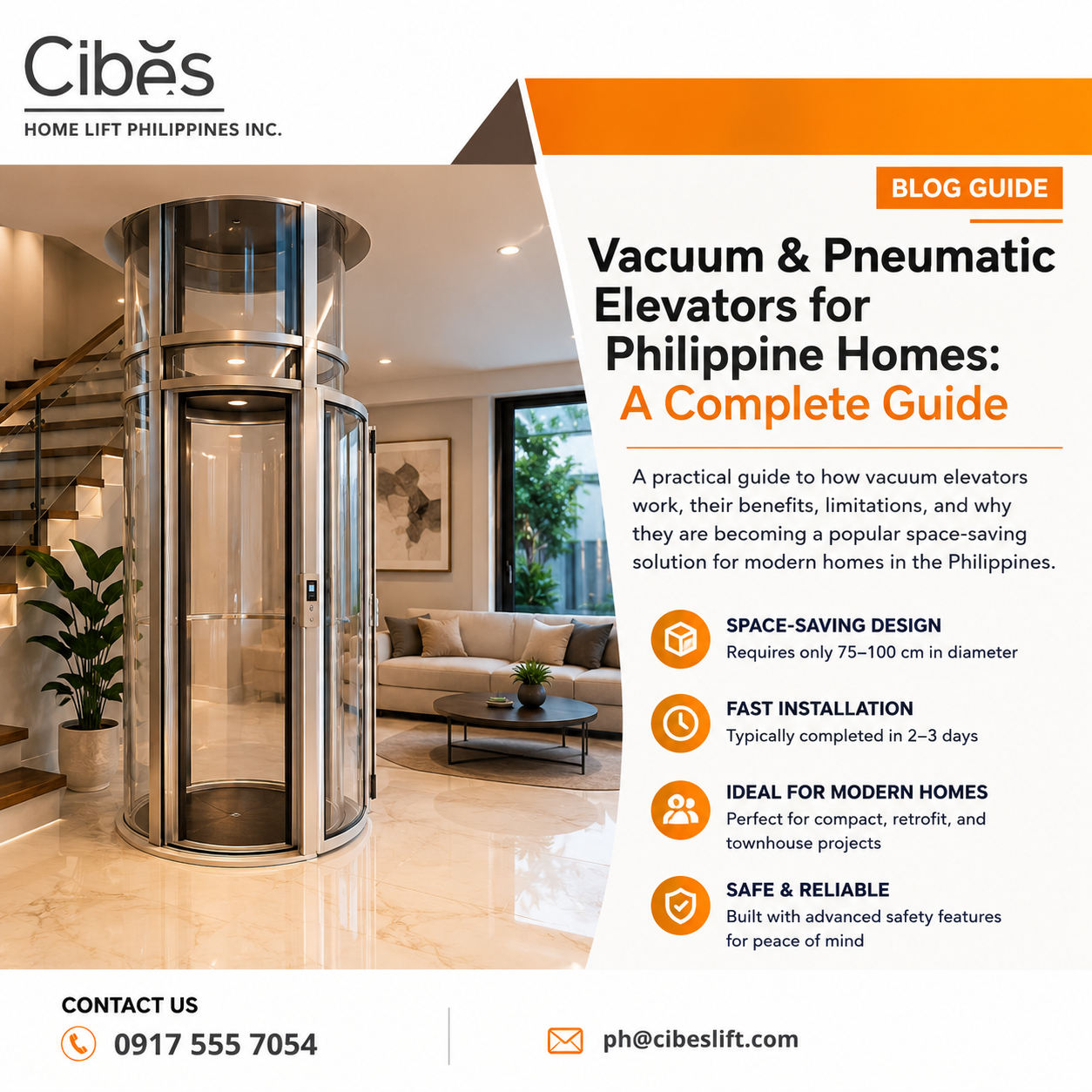
TL;DR Vacuum elevators use air pressure instead of cables or hydraulic systems to move a cabin inside a transparent tube. Most residential models require only 75 to 100 cm of space, serve 2 to 4 floors, carry 205 to 238 kg, and can often be installed in 2 to 3 days with minimal structural work. […]