Blog - 15/08/2026
Residential Elevator Dimensions in the Philippines: Cabin Size & Door Width
TL;DR
Residential elevator dimensions in the Philippines depend on the cabin size, door width, shaft requirements, and intended use. Before finalizing dimensions, homeowners should understand how elevator sizing affects installation space, accessibility, and long-term usability.
Our Home Elevator Installation & Dimensions in the Philippines: Complete Planning Guide provides a broader overview of residential elevator planning, including hoistway requirements, installation considerations, space allocation, and accessibility standards commonly used in Philippine homes.
Whether you’re building a new house or retrofitting an existing property, understanding the relationship between cabin dimensions, door openings, and available floor space can help prevent costly design changes later.
This guide focuses specifically on residential elevator cabin sizes, door widths, and the space requirements most commonly used in homes across the Philippines.
What are the standard residential elevator dimensions in the Philippines?
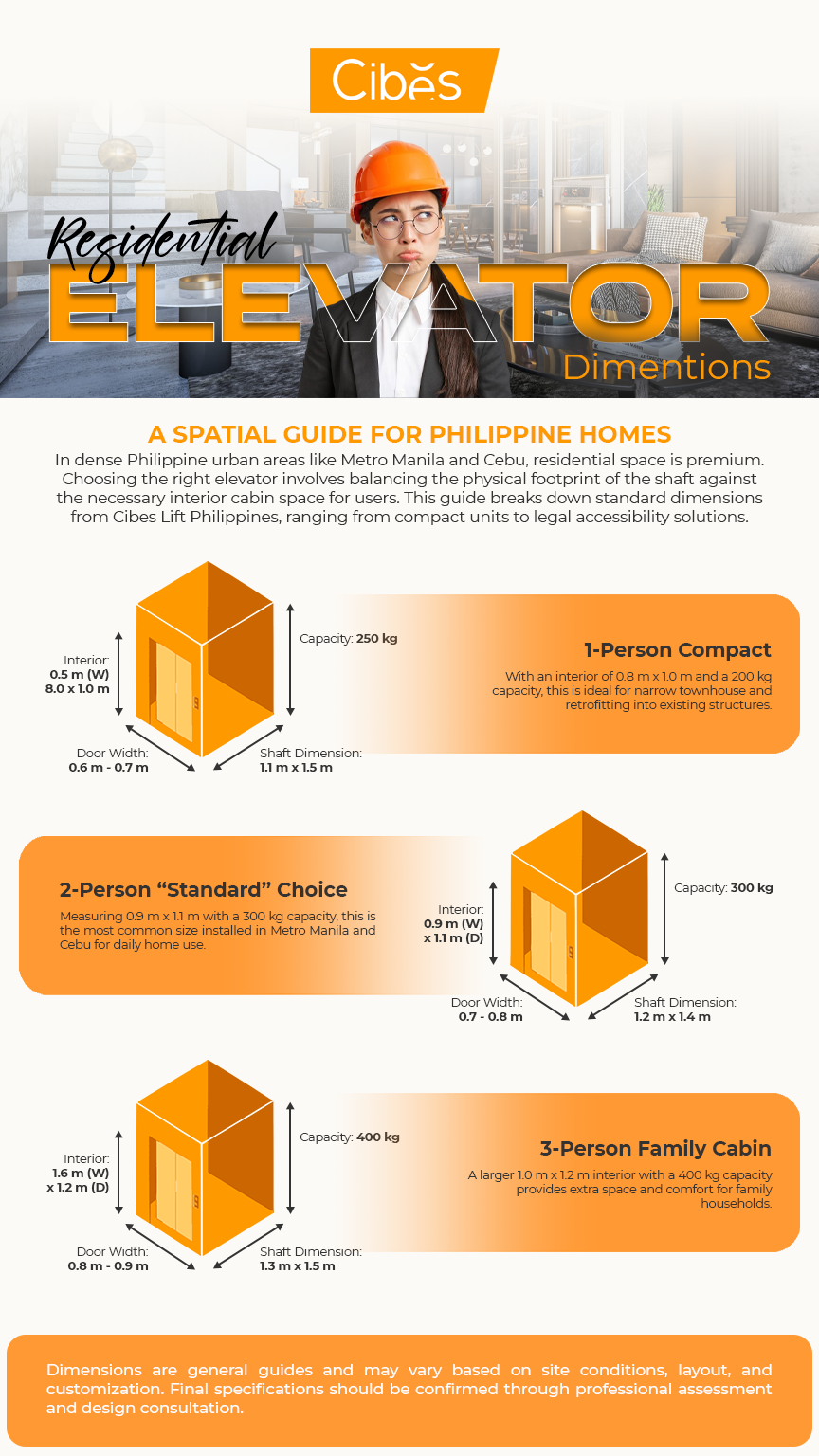
In the Philippines, home elevators typically range from 0.8 m × 1.0 m (compact) up to 1.4 m × 1.4 m (PWD-accessible).
For most homes in Metro Manila, Rizal, and Cebu, the go-to size installed by Cibes Lift Philippines Inc. is 0.9 m × 1.1 m, with a 0.7-0.8 m door and a 1.2 m × 1.4 m shaft. It fits standard layouts without taking too much floor space.
What cabin size fits your home layout?
Space is tight in many Philippine homes. So choosing the right cabin size matters early.
Standard Residential Elevator Sizes
| Cabin Type | Interior | Door | Shaft | Capacity | Best For |
| 1 Person | 0.8 × 1.0 m | 0.6-0.7 m | 1.1 × 1.3 m | 250 kg | Narrow townhouses, retrofits |
| 2 Persons | 0.9 × 1.1 m | 0.7-0.8 m | 1.2 × 1.4 m | 300 kg | Daily home use |
| 3 Persons | 1.0 × 1.2 m | 0.8-0.9 m | 1.3 × 1.5 m | 400 kg | Families, extra space |
In actual projects across Quezon City, Pasig, and Cebu, Cibes Lift Philippines Inc. often installs the 2-person size. It’s compact but still comfortable for daily trips.
What size elevator is required for wheelchair access?
Philippine law under Batas Pambansa Blg. 344 sets the minimum.
PWD Elevator Sizes
| Type | Interior | Door | Shaft | Capacity | Use Case |
| Minimum | 1.1 × 1.4 m | ≥ 0.9 m | 1.5 × 1.7 m | 400 kg | Basic wheelchair access |
| Comfortable | 1.4 × 1.4 m | 0.9-1.0 m | 1.7 × 1.7 m | 500 kg | With attendant, powered chairs |
The minimum works for compliance. But for real daily use, especially in family homes, the larger size feels more practical.
How much space do you really need?
The cabin is only part of the requirement.
Key Space Rules
- Shaft: Add 100-400 mm per side beyond cabin size
- Front clearance: At least 1.5 m in front of the door
- Door width: Usually 700-900 mm
Example:
A 1.0 × 1.2 m cabin needs about a 1.3 × 1.5 m shaft.
In many Philippine retrofits, this front clearance is the main constraint. It often affects hallway or room layout more than the shaft itself.
Which elevator size is right for your home?
A quick guide based on common Philippine setups:
- Small townhouse → 0.8 × 1.0 m
- Standard family home → 0.9 × 1.1 m
- More comfort → 1.0 × 1.2 m
- Accessibility / future use → 1.4 × 1.4 m
Most clients of Cibes Lift Philippines Inc. choose based on both current use and future needs. Going slightly bigger now can avoid limits later.
What should you watch out for?
A few practical limits seen in local projects:
- Small cabins feel tight for multiple users
- Minimum PWD size may not fit powered wheelchairs well
- 1.5 m clearance can be hard in narrow layouts
- Shaft size may limit upgrade options later
These are easier to solve during planning than after construction.
Frequently Asked Questions
Q: What are the standard dimension?
A: From 0.8 × 1.0 m to 1.4 × 1.4 m, with 0.9 × 1.1 m as the most common.
Q: What is the standard door width?
A: Around 700 mm to 900 mm.
Q: What size is needed for wheelchair access?
A: At least 1.1 × 1.4 m cabin with a 900 mm door.
Q: How much total space is required?
A: Add 100-400 mm per side for the shaft plus 1.5 m front clearance.
Q: What is the smallest elevator size?
A: About 0.8 × 1.0 m, ideal for tight spaces.
Learn More
- Standard Elevator Dimensions and Space Planning in the Philippines
- Elevator Shaft and Hoistway Dimension Requirements
Experience Center and Technical Station Address
Makati City | Balintawak – Quezon City | Mandaluyong City | Cebu City | Ilo-Ilo City | Davao City | Cagayan De Oro City






CIBES AUTHOR
Mylen Posas is the Aftersales Manager at Cibes Lift Philippines. She oversees aftersales operations, ensuring every customer receives reliable support from installation through long-term maintenance. With a strong focus on service quality and customer satisfaction, she works closely with the technical team to deliver prompt assistance and help maintain the long-term performance and safety of every Cibes home lift.



TL;DR Outdoor home elevators can improve accessibility while preserving valuable indoor space. In the Philippines, proper weather protection, structural engineering, drainage, and installation planning are essential. This guide explores installation considerations, safety requirements, potential costs, and what homeowners should know before choosing an outdoor home lift. Outdoor elevator installations can help homeowners in the Philippines […]

TL;DR The Cibes Experience Center Mindanao locations in Davao City and Cagayan de Oro City let homeowners, architects, contractors, and property developers explore home lift solutions in person. Compare available designs, check finishes, and discuss your property requirements with the Cibes team. Contact your preferred showroom before visiting to confirm operating hours and available demo […]
TL;DR The Cibes Experience Center Visayas in Cebu City lets homeowners, architects, designers, contractors, and developers see Cibes home lifts in person. Visitors can experience the lift cabin, review available designs and features, and discuss installation requirements with the Cibes team. The Cebu Experience Center currently lists V90 Elegance, Z85 Antera, and Ascenda among its […]
TL;DR Cibes Experience Center Luzon lets homeowners and property professionals experience Cibes home lifts in person before making a decision. Cibes Lift Philippines has 13 demo lifts across three Luzon Experience Centers: Makati (8), Mandaluyong (2), and Balintawak, Quezon City (3). Visitors can ride the lifts, check cabin space, test the controls, explore designs, and […]

TL;DR Sustainable home elevators in the Philippines are becoming an important consideration for homeowners who want to improve accessibility without overlooking environmental responsibility. Modern home elevators can support energy-efficient living through efficient drive systems, durable materials, renewable energy integration, and reduced structural changes compared with major home renovations. The Environmental Case for Sustainable Home Elevators […]